Introduction
India’s renewable-energy story is usually told through images of vast solar parks, rooftop photovoltaic panels, and ambitious capacity targets measured in gigawatts. While these developments are essential, they represent only one part of the energy puzzle. A significant share of India’s real energy consumption does not come from electricity at all, but from heat. Cooking for large communities, laundry operations, hospital sterilisation, space heating, cooling systems, and industrial processing all depend heavily on thermal energy, which is still largely produced by burning fossil fuels.
In this context, a quiet yet powerful innovation in Gujarat is drawing attention across the clean-energy sector. A giant Made-in-India solar dish, installed at Muni Seva Ashram, is demonstrating how solar energy can be used far beyond lighting homes or charging batteries. This system converts sunlight directly into high-temperature steam, replacing coal, diesel, and gas in daily operations. The result is not a pilot project or a laboratory experiment, but a fully functional energy system already transforming how a large institution consumes power.
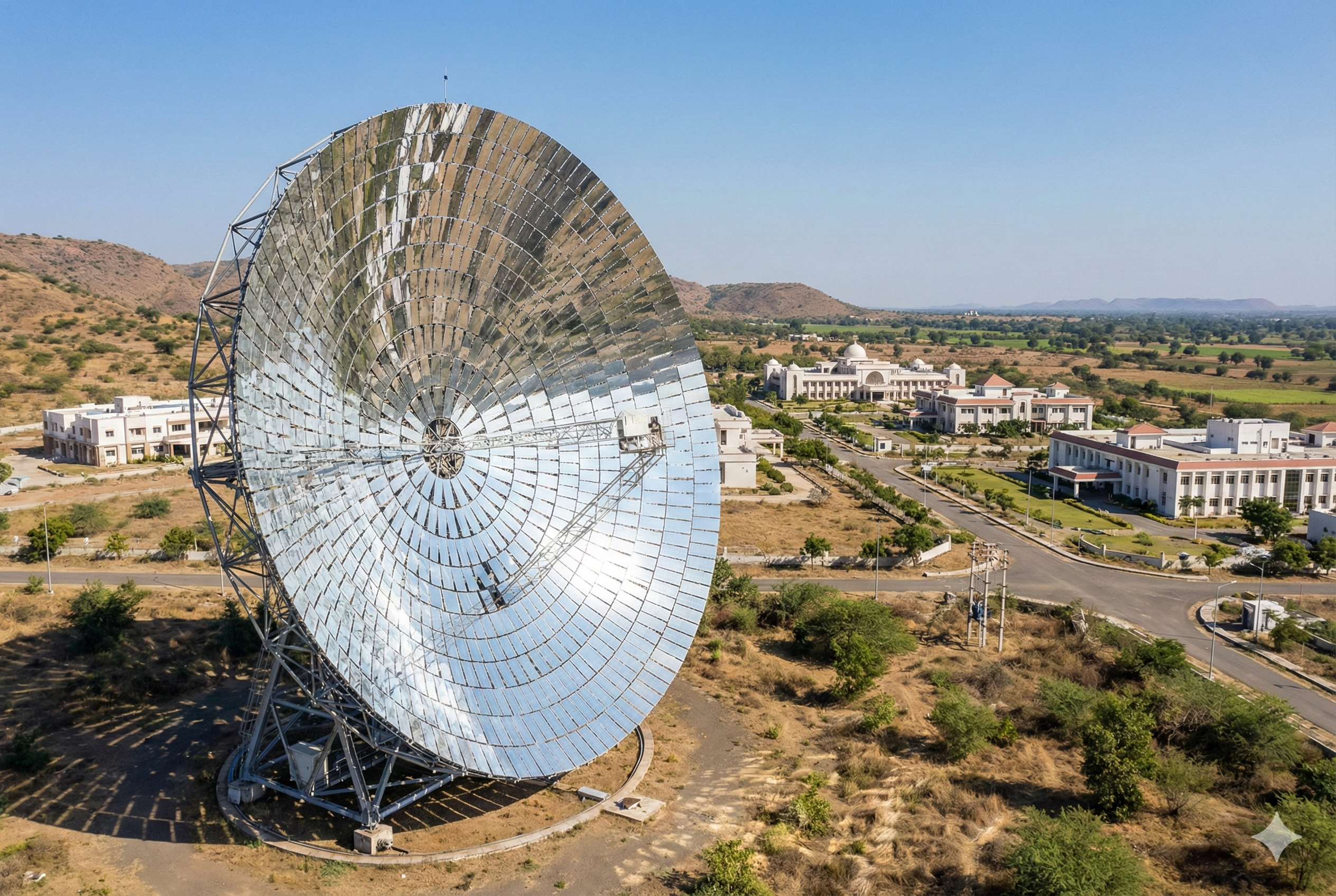
The scale of this solar dish alone makes it remarkable. With a diameter of approximately 26 metres and a height comparable to a seven-storey building, it is among the largest solar concentrator dishes operating in the country. More importantly, it proves that advanced solar thermal technology can be indigenised, manufactured locally, and deployed successfully under Indian conditions. At a time when energy costs are rising and sustainability commitments are becoming unavoidable, this project offers a glimpse into a future where clean heat plays a central role in India’s energy transition.
A Shift in How We Think About Solar Energy
For many people, solar energy is synonymous with photovoltaic panels. These panels convert sunlight into electricity, which can then be used to power appliances, charge batteries, or feed into the grid. While photovoltaic technology has become more affordable and widespread, it is not always the most efficient solution for applications that require heat rather than electricity.
The Made-in-India solar dish uses a different approach known as concentrated solar power. Instead of generating electricity first and then converting it into heat, the system captures solar radiation directly and converts it into thermal energy. Hundreds of precisely aligned mirrors form a parabolic structure that reflects sunlight onto a single focal point. As the dish tracks the sun throughout the day using automated software, the concentrated light generates extremely high temperatures at the receiver.
This heat is used to produce steam, which can then be channelled into existing systems for cooking, laundry, heating, cooling, or industrial processes. By eliminating intermediate steps, the system achieves high efficiency and avoids losses associated with electrical conversion and storage. This makes it particularly suitable for institutions and industries with large, consistent thermal energy demands.
Why the Location Matters
The installation site, Muni Seva Ashram in Goraj near Vadodara, is not just a spiritual centre but a large, active institution with hospitals, educational facilities, residential quarters, and service operations. Its daily energy requirements are substantial and varied, making it an ideal environment to test and scale solar thermal technology.
The ashram had already experimented with renewable energy solutions in the past, including a smaller solar dish installed several years ago. This earlier system was used primarily for cooking and laundry, proving that solar steam could reliably replace conventional fuel-based boilers. Encouraged by these results, the ashram decided to expand the concept dramatically with the installation of a much larger dish capable of handling heavier loads.
The decision to scale up was not merely symbolic. It was driven by practical considerations such as fuel costs, environmental responsibility, and long-term sustainability. By adopting a giant solar dish, the ashram aimed to reduce its dependence on fossil fuels while maintaining uninterrupted service for its residents and facilities.
From Cooking to Cooling: A Major Breakthrough
One of the most significant achievements of the new installation is its ability to power a 200-tonne air-conditioning plant using solar-generated steam. Air-conditioning systems are among the most energy-intensive infrastructures in large institutions, especially in India’s hot climate. Traditionally, such systems rely on electricity generated from coal-based power plants or on diesel generators during peak demand.
By using solar steam to drive the cooling system, the ashram has demonstrated that even high-load applications can be decarbonised using renewable energy. This marks a major shift in how solar technology is perceived. It is no longer limited to supplementing energy needs; it is capable of replacing conventional systems entirely for certain applications.
The implications of this achievement extend far beyond a single campus. Hospitals, hotels, industrial facilities, and large residential complexes across India face similar cooling demands. The success of this solar dish suggests that solar thermal systems could play a crucial role in reducing the carbon footprint of cooling infrastructure nationwide.
Indigenous Engineering and Make-in-India Impact
Although the concept of large solar concentrator dishes has been explored internationally, particularly in research institutions abroad, its widespread adoption has often been limited by economic and infrastructural factors. In some countries, the availability of cheap fossil fuels has made solar thermal solutions less competitive.
In India, however, rising fuel prices, increasing environmental awareness, and supportive government policies have created a favourable environment for such technologies. The solar dish installed at Muni Seva Ashram has been manufactured and adapted locally, aligning with the country’s broader push for self-reliance and domestic manufacturing.
Local production not only reduces costs but also ensures easier maintenance, faster deployment, and better adaptation to Indian climatic conditions. This project demonstrates that advanced clean-energy technologies do not need to be imported at high cost; they can be developed, refined, and scaled within the country.
Economic Logic Behind Solar Steam
One of the most common concerns about large renewable-energy installations is their upfront cost. Solar concentrator dishes do require significant initial investment, particularly for precision components such as mirrors, tracking systems, and structural supports. However, evaluating the system solely on installation cost overlooks its long-term economic benefits.
Once operational, the Made-in-India solar dish produces energy at virtually zero fuel cost. Sunlight is free, abundant, and unaffected by global price fluctuations. Over time, the savings generated by eliminating coal, diesel, or gas consumption can offset the initial investment. Additionally, maintenance costs are relatively low compared to fuel-based systems, as there is no combustion, no emissions control equipment, and fewer consumable components.
For institutions with predictable daily energy needs, the payback period becomes increasingly attractive, especially when combined with government incentives and grants for renewable-energy adoption.
Environmental and Social Benefits
Beyond financial considerations, the environmental impact of replacing fossil fuels with solar steam is substantial. The solar dish operates without emitting greenhouse gases, particulate matter, or toxic pollutants. This contributes to improved air quality, reduced carbon emissions, and better health outcomes for communities.
In institutional settings such as hospitals and ashrams, cleaner energy also translates into quieter operations and a safer working environment. The absence of smoke, ash, and fuel storage reduces operational risks and simplifies compliance with environmental regulations.
Socially, projects like this serve as powerful demonstrations of what is possible when sustainability is prioritised. They inspire confidence among policymakers, investors, and the public, encouraging further adoption of clean-energy solutions.
Support, Funding and Collaboration
The success of the solar dish installation has been supported by contributions from various organisations that recognise the importance of solar thermal technology. Financial and institutional backing from Rotary Club of Bombay Pier and United Nations Industrial Development Organization has played a key role in scaling the project.
Additionally, the ashram’s hospital unit is registered as a micro, small, and medium enterprise, enabling it to access government grants for renewable-energy initiatives. This combination of private support, international collaboration, and public incentives illustrates a model that can be replicated across the country.
Broader Implications for Industry
The success of the Made-in-India solar dish has already sparked interest beyond the ashram. Industrial units in cities such as Hyderabad are exploring similar installations for process heat and cooling applications. Sectors such as food processing, textiles, pharmaceuticals, and chemicals rely heavily on steam and could benefit significantly from solar thermal systems.
Unlike photovoltaic installations, which often require grid integration and energy storage solutions, solar dishes can be integrated directly into existing thermal infrastructure. This reduces complexity and accelerates adoption, particularly for industries seeking quick wins in sustainability.
Addressing Challenges and Limitations
Despite its many advantages, solar concentrator technology is not without challenges. The system requires high solar irradiation, making it most effective in regions with clear skies and abundant sunlight. Accurate installation and alignment are critical to achieving optimal performance, necessitating skilled engineering and regular maintenance checks.
Initial capital investment can also be a barrier for smaller institutions or businesses. However, as manufacturing scales up and awareness increases, costs are expected to decline. When combined with financing options, subsidies, and long-term fuel savings, solar dishes become an increasingly viable option.
A New Direction for India’s Energy Transition
India’s commitment to achieving net-zero emissions and reducing its dependence on imported fuels requires a diversified approach to renewable energy. Electricity generation alone will not suffice. Heat and cooling must also be addressed, particularly in sectors that are difficult to electrify.
The Made-in-India solar dish at Muni Seva Ashram provides a compelling example of how this can be achieved. By harnessing solar energy directly for thermal applications, it fills a critical gap in the renewable-energy landscape.
Conclusion
The giant Made-in-India solar dish installed in Gujarat represents more than an impressive engineering feat. It is a practical, working solution that addresses real energy needs while reducing environmental impact. By transforming sunlight into usable steam for cooking, laundry, cooling, and other applications, it challenges the conventional notion of what solar energy can achieve.
As India continues its transition towards a cleaner and more sustainable energy system, technologies like solar concentrator dishes will play an increasingly important role. They offer a pathway to decarbonising sectors that have long relied on fossil fuels, proving that renewable energy can be both versatile and reliable.
This project stands as a reminder that meaningful change often begins with practical action. One institution, one innovation, and one well-designed system can pave the way for a broader transformation in how energy is produced and consumed across the country.
Also Read : Key Challenges in Solar Adoption : A Complete Analysis