Introduction: A New Way of Farming for Indian Farmers
Indian agriculture is standing at a turning point. Rising electricity costs, irregular power supply, water scarcity, unpredictable weather, and shrinking farm profits are making farming more challenging every year. At the same time, India is rapidly moving towards clean and renewable energy, especially solar power.
But what if farmers did not have to choose between farming and solar energy? What if the same land could grow crops and generate electricity at the same time?
This is where agrivoltaics comes in.
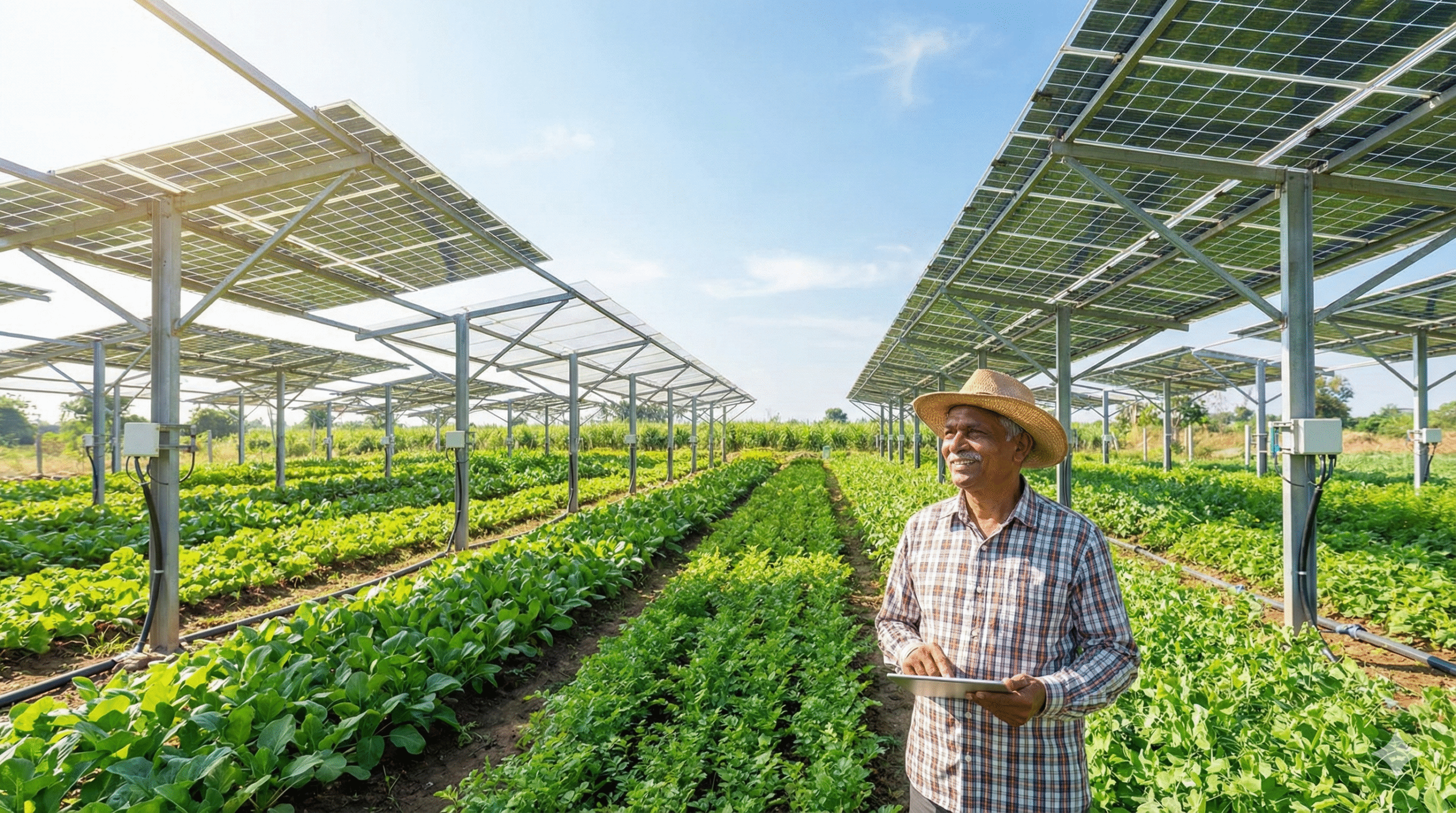
Agrivoltaics is an innovative farming model where crops are grown under or between solar panels. Instead of installing solar plants on empty land, solar panels are raised above farmland so farming can continue normally below. This approach allows farmers to earn from agriculture while also producing clean electricity.
For Indian farmers and agri startups, agrivoltaics is not just a technology trend. It is a practical solution to increase income, reduce risk, save water, and make farming more climate-resilient. This blog explains agrivoltaics in simple language and shows why it can become the future of smart farming in India.
What Is Agrivoltaics? (Explained Simply)
Agrivoltaics, also known as agri-solar or dual-use solar farming, is a system where solar panels and agriculture coexist on the same piece of land. The solar panels are installed in such a way that crops can grow beneath them or between rows.
In a traditional solar plant, land is used only for electricity generation. In agrivoltaics, land works double – it produces food and energy together.
The key idea is simple:
- Solar panels are installed at a height or with spacing
- Crops receive partial sunlight instead of direct harsh sunlight
- Electricity is generated from solar panels
- Farmers continue farming as usual
This approach is especially suitable for India, where land is precious and farming supports millions of livelihoods.
Why Agrivoltaics Is Important for India
India has one of the largest farming populations in the world. At the same time, it has high solar potential with abundant sunlight across most regions. Agrivoltaics connects these two strengths.
Key reasons agrivoltaics fits India perfectly:
- Land scarcity: Farmers cannot afford to lose farmland for solar projects.
- High sunlight: Excess sunlight often damages crops during extreme heat.
- Rising input costs: Electricity and diesel costs are increasing every year.
- Water stress: Many regions face groundwater depletion.
- Need for extra income: Farming income alone is often not enough.
Agrivoltaics directly addresses all these problems by using land more efficiently and creating an additional income source.
How Agrivoltaics Works on a Farm
Agrivoltaic systems are designed based on crop type, climate, and farming method. The basic components include:
- Elevated solar panel structures
- Proper spacing between panels
- Farming activity below or between panels
- Grid connection or on-farm electricity use
Solar panels are usually installed 8–15 feet above ground, allowing sunlight to filter through. Crops receive diffused light instead of direct heat. This creates a better microclimate for many crops.
Electricity produced can be used for:
- Irrigation pumps
- Cold storage
- Farm machinery
- Household power
- Selling to the grid for extra income
Benefits of Agrivoltaics for Indian Farmers
1. Extra Income from Solar Power
One of the biggest advantages of agrivoltaics is additional income. Farmers can earn money by selling electricity to the grid or leasing the solar structure to developers while continuing agriculture.
This extra income acts as a safety net during:
- Poor monsoon seasons
- Crop failure
- Market price fluctuations
2. Reduced Crop Heat Stress
In many parts of India, extreme heat damages crops. Solar panels provide partial shade, which:
- Reduces heat stress
- Protects crops from direct sunlight
- Improves plant growth in hot climates
3. Water Savings
Shade from solar panels reduces evaporation from soil. This means:
- Less water is required for irrigation
- Soil retains moisture longer
- Better water efficiency, especially in dry regions
4. Better Land Productivity
Instead of choosing between crops or solar, agrivoltaics allows farmers to do both. Overall productivity per acre increases.
5. Climate Resilience
With climate change causing irregular weather, agrivoltaics provides more stable farming conditions and income diversification.
Crops Suitable for Agrivoltaics in India
Not all crops react the same way to shade. However, many Indian crops perform well under partial sunlight.
Best crop categories:
- Leafy vegetables: Spinach, fenugreek, coriander, lettuce
- Spices: Turmeric, ginger, cardamom
- Pulses: Some varieties of beans and legumes
- Fodder crops: Napier grass, clover
- Medicinal plants: Tulsi, aloe vera, ashwagandha
These crops often benefit from reduced heat and improved moisture conditions.
Types of Agrivoltaic System Designs
1. Elevated Structure Agrivoltaics
Solar panels are mounted high above the ground, allowing tractors and workers to move freely.
Best for: Large farms, mechanised farming
2. Row-Spacing Agrivoltaics
Panels are installed in rows with crops grown between them.
Best for: Small and medium farms
3. Solar Greenhouses
Solar panels are integrated with greenhouse roofs.
Best for: High-value crops and controlled farming
4. Solar Grazing
Livestock graze under solar panels.
Best for: Dairy and mixed farming systems
Cost and Economics of Agrivoltaics
Initial Cost
Agrivoltaic systems cost more than standard solar installations because of taller structures. However, long-term benefits outweigh initial investment.
Revenue Sources
- Sale of electricity
- Reduced electricity bills
- Continued crop income
- Reduced water usage
Return on Investment
Most agrivoltaic systems can recover costs within 5–7 years, depending on system size and tariff structure.
Role of Agrivoltaics in Smart Farming
Agrivoltaics fits perfectly into the concept of smart farming. When combined with:
- Drip irrigation
- IoT soil sensors
- AI-based crop monitoring
Farmers can optimise both energy and agriculture. Solar energy powers smart tools, making farms more efficient and future-ready.
New Innovations in Agrivoltaics
Agrivoltaics is evolving rapidly with new technologies:
- Semi-transparent solar panels
- Adjustable solar trackers
- AI-controlled shading systems
- Floating solar over farm ponds
These innovations will make agrivoltaics even more effective in coming years.
Challenges and How to Overcome Them
Common Challenges:
- High initial cost
- Lack of awareness
- Policy clarity
Solutions:
- Government support and subsidies
- Pilot projects
- Farmer training programs
- Partnerships with solar companies
Step-by-Step Guide for Farmers to Start Agrivoltaics
- Assess farmland and crop type
- Consult an agrivoltaic expert
- Choose suitable system design
- Explore financing or partnership models
- Install solar structure
- Monitor crop and energy performance
Future of Agrivoltaics in India
With rising energy demand and climate challenges, agrivoltaics will play a major role in India’s agricultural transformation. It supports sustainable farming, renewable energy goals, and farmer income growth.
Government policies, agri startups, and solar companies will together drive adoption at scale.
Conclusion: A Win-Win Model for Farmers and the Planet
Agrivoltaics is not just about solar panels or crops. It is about smarter land use, higher income, water conservation, and climate resilience.
For Indian farmers, agrivoltaics offers a rare opportunity to grow food and generate energy together. As technology improves and awareness grows, agrivoltaics can become a mainstream farming practice across India.
If adopted wisely, agrivoltaics can truly shape the future of smart farming.
In India, agrivoltaics aligns well with renewable energy goals supported by the Ministry of New and Renewable Energy (MNRE).
Also Read: Key Challenges in Solar Adoption: A Complete Analysis