India 20% Domestic Content Battery Storage Projects: Policy Impact, Industry Response, and Future Outlook
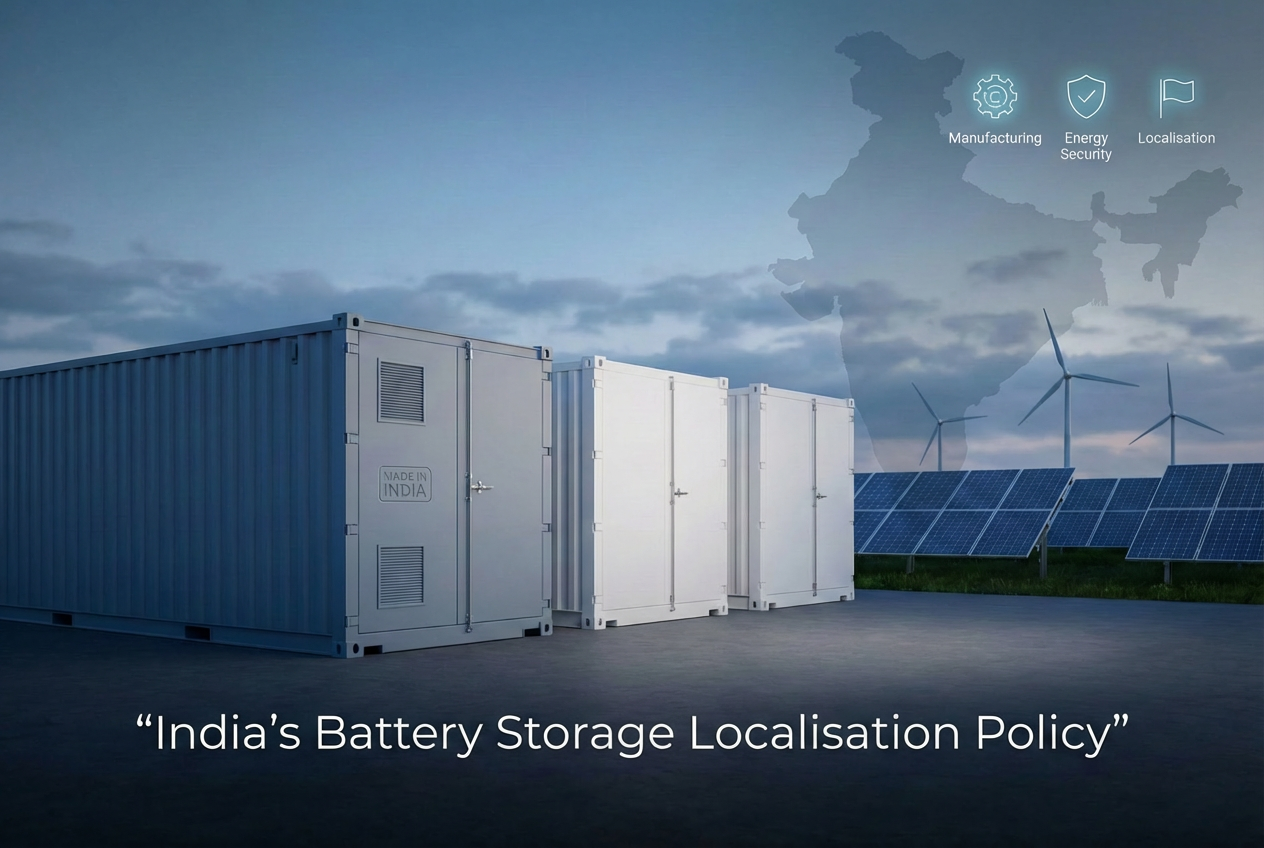
India’s clean energy transition has reached a decisive moment with the introduction of a new policy affecting battery energy storage systems. Under a recent directive, India mandates 20% domestic content in battery storage projects that receive central government financial support. This policy marks a strategic shift in how India approaches energy storage, manufacturing localisation, and long-term energy security.
Battery energy storage systems are rapidly becoming the backbone of India’s renewable-heavy power grid. As solar and wind capacity grow, storage is no longer optional. Recognising this reality, the Government of India has introduced a battery storage domestic content rule that ensures Indian manufacturers and service providers participate meaningfully in this fast-growing sector.
This article provides a complete analysis of the India 20% domestic content battery storage projects policy, its rationale, its impact on developers and manufacturers, and how it will shape India’s energy storage ecosystem in the coming decade.
According to the latest Ministry of Power guidelines, the 20% domestic content requirement applies to battery energy storage projects receiving central government financial support.
Understanding the India 20% Domestic Content Battery Storage Projects Policy
The India battery storage domestic content policy requires that at least 20% of the total project value in eligible battery energy storage systems must come from domestically manufactured components or services. This requirement applies specifically to projects that receive funding support from the central government.
The directive was issued by the Ministry of Power and applies to battery storage projects supported under schemes such as Viability Gap Funding and other central power sector funding mechanisms.
The policy does not mandate complete localisation. Instead, it introduces a measured domestic sourcing rule for battery storage systems, allowing developers to continue importing critical components while ensuring that a meaningful portion of the value chain remains within India.
Why India Is Introducing a Domestic Content Requirement for Battery Storage
The introduction of the 20% local content requirement for battery storage is driven by several strategic considerations that go beyond short-term cost factors.
Reducing Import Dependence in Battery Energy Storage Systems
India currently relies heavily on imported battery cells, modules, and power electronics. This dependence exposes battery storage projects to foreign exchange risks, global supply disruptions, and geopolitical uncertainty. By enforcing a battery energy storage domestic content rule, India aims to gradually reduce this vulnerability.
Strengthening Energy Security Through Local Manufacturing
Energy security in a renewable-dominated grid depends not only on power generation but also on storage availability. The India BESS domestic content policy helps ensure that future grid stability does not rely entirely on foreign supply chains.
Supporting Make in India Through Battery Storage Manufacturing
Battery storage is a high-value sector with strong employment and technology spillovers. The domestic content requirement aligns with Make in India objectives by promoting local manufacturing of battery storage components, software, and system integration services.
Role of Battery Energy Storage Systems in India’s Power Sector
To understand why the India battery storage localisation mandate matters, it is essential to understand the role of storage in India’s power system.
Battery energy storage systems allow renewable power generated during off-peak hours to be stored and dispatched when demand rises. They improve grid frequency control, enable peak shaving, reduce renewable curtailment, and support faster coal phase-down.
As India targets large-scale renewable integration, battery storage projects are expected to grow rapidly. The India 20% domestic content battery storage projects policy ensures that this growth contributes to domestic industrial development.
What Qualifies as Domestic Content Under India’s Battery Storage Policy
A common concern among developers is how domestic content is calculated under the battery storage domestic content rule.
Domestic content may include:
- Battery pack assembly carried out in India
- Battery management systems manufactured or developed locally
- Power conversion systems produced by Indian manufacturers
- Energy management software developed in India
- Structural components, enclosures, and balance-of-plant equipment sourced domestically
- Engineering, procurement, construction, and system integration services provided by Indian firms
This flexibility allows developers to meet the 20% local content requirement for battery storage without compromising project timelines or technology performance.
Applicability of the India Battery Storage Domestic Content Policy
The India 20% domestic content battery storage projects mandate applies to battery energy storage systems that receive central government financial support. State governments and implementing agencies are required to incorporate this requirement into tender documents and contracts.
Projects developed without central funding are not directly covered. However, market behaviour suggests that domestic content norms often become informal benchmarks even outside mandatory frameworks.
Impact on Developers and EPC Companies
The India battery storage domestic content policy introduces new considerations for developers and EPC contractors.
Procurement Strategy Changes
Developers must now integrate domestic sourcing into procurement planning from the early stages. Waiting until late-stage procurement increases compliance risk.
Cost Implications of Domestic Content in Battery Storage Projects
While some domestic components may be marginally more expensive in the short term, the limited 20% threshold reduces overall cost impact. Over time, scale and competition are expected to narrow the cost gap.
Improved Supply Chain Stability
Local sourcing reduces shipping delays, import duties, and currency volatility. This improves execution certainty, a critical factor for large battery energy storage projects.
Opportunities for Indian Manufacturers Under the Battery Storage Localisation Mandate
For Indian manufacturers, the India BESS domestic content policy creates strong demand visibility.
Expansion of Battery Pack Assembly and Integration
Domestic battery pack assembly is one of the fastest-growing segments under the battery energy storage domestic content rule. Companies investing early are likely to benefit from recurring demand.
Growth of Software and Energy Management Systems
India’s software strength gives it a natural advantage in battery management systems and energy optimisation platforms. These areas count toward domestic content and offer high margins.
Joint Ventures and Technology Transfer
Global battery suppliers may increasingly partner with Indian firms to meet domestic content requirements, accelerating knowledge transfer and skill development.
Alignment With India’s Broader Energy and Manufacturing Policies
The India 20% domestic content battery storage projects policy complements existing initiatives such as Production Linked Incentive schemes for advanced chemistry cells, grid modernisation programmes, and renewable procurement reforms.
Together, these policies create an integrated ecosystem where manufacturing, deployment, and grid integration evolve simultaneously rather than in isolation.
Comparison With Solar Domestic Content Requirements
India’s earlier experience with solar domestic content rules offers valuable lessons. Unlike early solar policies, the battery storage domestic content rule is flexible, modest in scope, and introduced at an early stage of market development.
This reduces trade risks, avoids abrupt cost escalation, and allows supply chains to mature organically.
Challenges in Implementing the Battery Storage Domestic Content Policy
Despite its advantages, the India battery storage localisation mandate faces several challenges.
Limited domestic manufacturing capacity in the short term may strain supply chains. Clear certification mechanisms are needed to verify domestic content without adding administrative complexity. Policy stability is essential to maintain investor confidence.
Addressing these challenges requires coordination between policymakers, industry stakeholders, and financial institutions.
Long-Term Outlook for India Battery Storage Domestic Content Requirements
Industry consensus suggests that the 20% local content requirement for battery storage is a starting point rather than a final target. As domestic manufacturing scales, localisation thresholds may increase gradually.
Future revisions are likely to be data-driven, based on cost trends, supply readiness, and grid requirements.
What the Policy Means for India’s Clean Energy Transition
From a strategic perspective, the India 20% domestic content battery storage projects policy strengthens India’s clean energy transition by aligning climate goals with industrial development.
It ensures that as battery storage becomes central to grid operations, India retains control over critical technologies and supply chains. It also positions India as a potential exporter of battery storage solutions to emerging markets.
Conclusion: Why India’s Battery Storage Domestic Content Policy Matters
The decision to mandate domestic content in battery energy storage systems is a carefully balanced policy move. By setting a realistic threshold, India avoids market disruption while sending a clear signal about long-term priorities.
For developers, it encourages smarter procurement and local partnerships. For manufacturers, it unlocks new growth opportunities. For the country, it enhances energy security and industrial competitiveness.
As battery storage deployment accelerates, the India 20% domestic content battery storage projects mandate may well become one of the most influential policies shaping India’s renewable energy future.
Also Read : Giant Made-in-India Solar Dish Transforming Energy Use in Gujarat