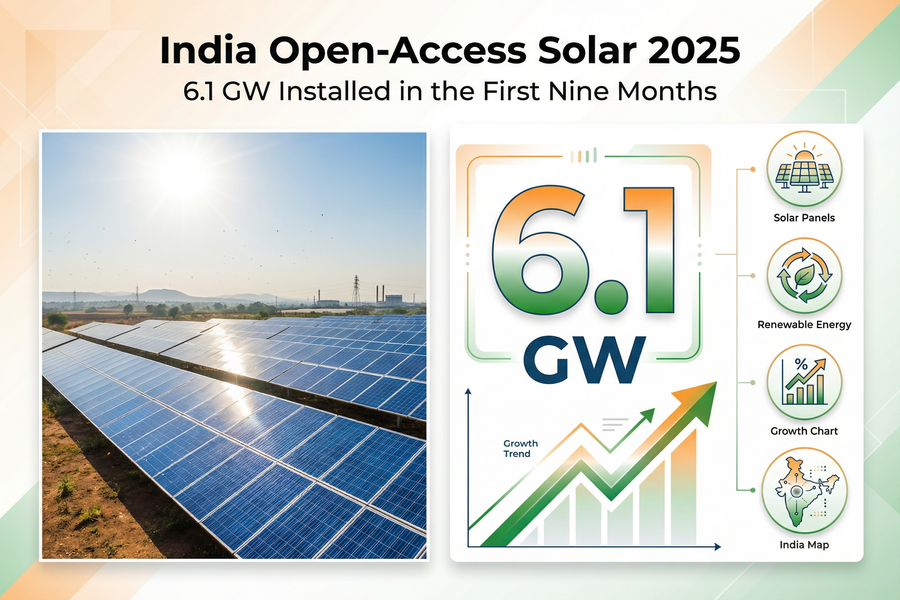
India open-access solar 2025 has become a major highlight in the country’s clean energy landscape. In the first nine months of 2025, India added 6.1 gigawatts (GW) of open-access solar capacity, marking a strong 13% increase compared to the same period last year. This rapid growth shows how quickly commercial and industrial consumers are shifting towards clean, affordable, and independent renewable energy. With open-access solar contributing significantly to India’s renewable energy targets, India open-access solar 2025 is proving to be one of the most influential chapters in the nation’s energy transition.
“According to reports from the Ministry of New and Renewable Energy (MNRE), India’s solar adoption continues to accelerate across all segments.”
Understanding India’s Open-Access Solar 2025 Growth
Open-access solar allows large consumers—mainly commercial and industrial users—to buy solar power directly from developers instead of relying completely on state utilities. This model gives businesses the freedom to choose where their energy comes from, negotiate long-term tariffs, and rely on clean power without building their own solar plants.
The strong numbers seen in India open-access solar 2025 are driven by rising energy prices, sustainability commitments, and the need for stable long-term electricity. As more companies adopt net-zero goals and strengthen their ESG strategies, open-access solar has become a preferred energy solution.
Businesses in manufacturing, data centres, textiles, logistics, FMCG, IT parks, and infrastructure development are now embracing open-access solar as a predictable and cost-effective way to manage their power needs.
Why India Open-Access Solar 2025 Capacity is Growing Rapidly
Several powerful factors are driving the 6.1 GW growth seen in the first nine months of 2025.
1. Strong Adoption by Corporate & Industrial Consumers
Industries across India are adopting solar energy not only to reduce operational costs but also to increase sustainability. With open-access solar, companies lock in predictable tariffs for 10–25 years, reducing their exposure to rising grid tariffs. As environmental responsibility becomes important for brand reputation, more organisations are turning to solar to meet energy goals.
2. Rising Overall Growth in the Solar Sector
The open-access segment is part of a much larger solar expansion happening in the country. India added more than 26 GW of solar capacity in 2025 across utility-scale, rooftop, and open-access segments. Large-scale solar continues to dominate, but open-access installations form a significant part of new capacity additions, driven by high C&I demand.
3. Leading States Supporting Open-Access Solar
Karnataka, Maharashtra, Tamil Nadu, Rajasthan, and Gujarat are leading the growth of open-access solar in India. Their favourable policies, strong grid networks, and supportive state-level frameworks make them attractive locations for developers and consumers.
4. Awareness About Long-Term Benefits
Many large consumers are now aware of the financial and environmental advantages of procuring solar power through open access. Long-term savings, carbon footprint reduction, and energy independence make it a highly practical and future-ready solution.
Impact of India Open-Access Solar Expansion in 2025
The rise of India open-access solar 2025 has brought several major benefits to the overall energy landscape.
1. A Stronger Renewable Energy Ecosystem
The consistent addition of open-access capacity drives investment in solar manufacturing, EPC services, power infrastructure, and financing. This contributes to job creation, faster adoption of clean technology, and stronger local industries.
2. Lower Carbon Emissions
Every megawatt of solar power reduces the need for fossil-fuel-based electricity. The 6.1 GW added in 2025 represents a large cut in greenhouse gas emissions. As India works toward its 2030 climate commitments, open-access solar plays a key role in achieving sustainability milestones.
3. Energy Independence for Businesses
One of the biggest advantages of open-access solar is that it gives businesses more control over their energy sources. Industries no longer depend solely on grid electricity. This independence helps companies optimise energy usage, plan better, and protect themselves from tariff fluctuations.
4. A Boost to India’s Renewable Targets
With India aiming to achieve ambitious renewable energy goals, the growth in the open-access segment significantly supports the national mission. Open-access solar could soon become a dominant source of clean energy for large consumers.
Challenges Slowing Down India’s Open-Access Solar 2025 Push
Even though the performance is strong, there are several challenges that need to be addressed to accelerate further growth.
1. Grid and Transmission Limitations
Many regions lack adequate infrastructure to handle new renewable energy capacity. Weak transmission lines, overloaded substations, and limited evacuation capacity cause delays in connecting new solar plants to the grid.
2. Slow Approval Processes
Open-access projects require multiple approvals, including open-access permissions, grid connectivity, metering, and energy wheeling permissions. In some states, these processes are slow, causing long project delays.
3. Policy Differences Between States
Since open-access policies vary across India, developers often face uncertainty in understanding charges and regulations. Frequent changes in state policies can affect the financial planning of large renewable projects.
4. Land and Infrastructure Constraints
In high-demand states, land availability and grid access near renewable corridors are becoming challenging. These limitations restrict how quickly developers can add new capacity.
Despite these issues, the consistent growth seen in India open-access solar 2025 shows that demand remains strong and the sector is progressing steadily.
Future of India Open-Access Solar 2025 and Beyond
The future of open-access solar in India looks extremely promising. If the current pace continues, the coming years may witness major changes in the country’s energy landscape.
What to Expect Next:
- Rapid expansion of hybrid solar-plus-storage projects to ensure round-the-clock renewable energy.
- Increased participation from data centres and large industrial clusters switching fully to open-access solar.
- Stronger transmission networks designed to support high renewable penetration.
- Policy reforms to make open-access adoption smoother and more uniform nationwide.
- Greater corporate commitment toward net-zero goals, pushing higher renewable procurement.
As businesses continue to prioritise sustainability, open-access solar will play a central role in India’s journey toward becoming a global clean-energy leader.
Conclusion
The addition of 6.1 GW in the first nine months shows that India open-access solar 2025 is shaping the future of industrial and commercial energy consumption. With strong demand, increasing awareness, and long-term cost benefits, open-access solar has become a powerful alternative to traditional grid-based electricity.
Although challenges like grid limitations, policy uncertainty, and infrastructure constraints remain, the overall direction is clear. Open-access solar will continue to grow and contribute meaningfully to India’s renewable targets.
As India strengthens its policies, infrastructure, and green commitments, the open-access solar sector will evolve into one of the most significant drivers of sustainable growth. The momentum seen in 2025 is not just progress—it is the foundation for a cleaner, more resilient energy future.
Also Read : Solar Size Calculation: How to Choose the Right Solar System