Introduction
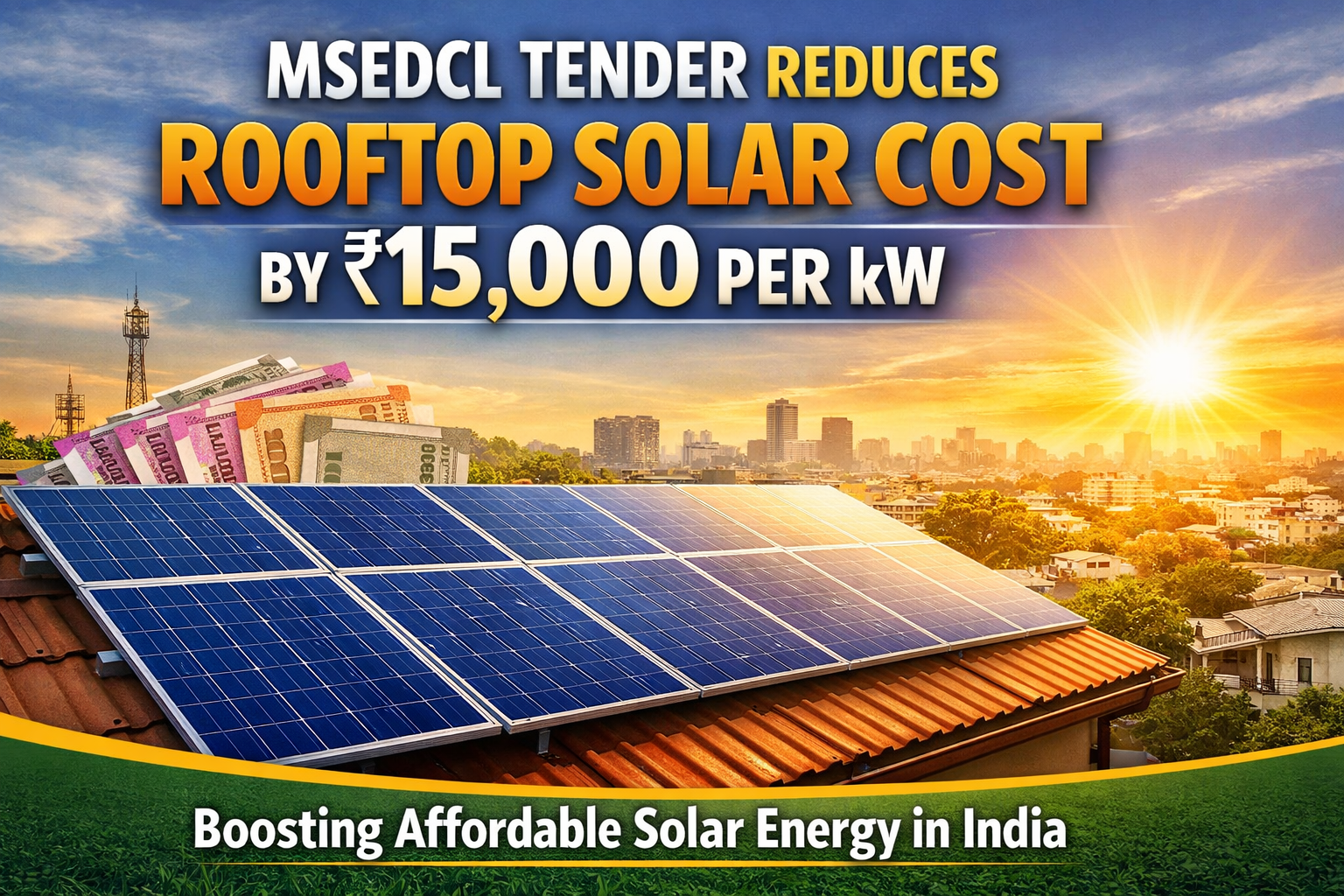
India’s renewable energy transition is accelerating rapidly, and rooftop solar energy is emerging as one of the most powerful solutions for affordable electricity. Recently, the Maharashtra State Electricity Distribution Company Limited (MSEDCL) announced a significant breakthrough that has captured national attention. Through a competitive tender process, rooftop solar installation costs have been reduced by approximately ₹15,000 per kilowatt (kW).
This MSEDCL rooftop solar cost reduction marks a major milestone in India’s clean energy journey. The new pricing makes solar energy more accessible, especially for low-income households, while supporting the country’s long-term sustainability goals.
In this article, we explore how the tender works, why the price reduction matters, and what it means for consumers, the solar industry, and India’s energy future.
What Is the MSEDCL Rooftop Solar Scheme?
The MSEDCL rooftop solar initiative is part of Maharashtra’s SMART Solar Scheme, designed to promote residential solar adoption across the state. The program focuses mainly on households consuming less than 100 electricity units per month.
The scheme aims to install rooftop solar systems for nearly five lakh families, particularly those belonging to economically weaker sections and below-poverty-line categories.
Unlike earlier subsidy-driven programs, this initiative reduces costs directly through large-scale tendering. As a result, installation prices dropped from around ₹60,000 per kW to ₹45,450 per kW.
This price discovery demonstrates how strategic procurement can transform renewable energy affordability.
How the ₹15,000 Per kW Cost Reduction Was Achieved
The MSEDCL rooftop solar cost reduction became possible due to competitive bidding among empanelled solar vendors.
Key factors behind the price drop:
- Bulk procurement advantages
- Standardised installation processes
- Reduced marketing and distribution expenses
- Economies of scale
- Government-backed demand assurance
When vendors compete for large government projects, they optimize supply chains and reduce margins, ultimately benefiting consumers.
This approach ensures transparency while maintaining installation quality.
Rooftop Solar Pricing: Before vs After the Tender
| System Size | Earlier Market Cost | New Tender Cost | Savings |
|---|---|---|---|
| 1 kW | ₹60,000 | ₹45,450 | ₹14,550 |
| 2 kW | ₹120,000 | ₹90,900 | ₹29,100 |
| 3 kW | ₹180,000 | ₹136,350 | ₹43,650 |
The reduced pricing significantly lowers entry barriers for residential solar adoption.
Integration with PM Suryaghar Muft Bijlee Yojana
The MSEDCL initiative aligns closely with India’s national rooftop solar mission.
Under the central government program, households receive subsidies such as:
- ₹30,000 for 1 kW systems
- ₹60,000 for 2 kW systems
- Up to ₹78,000 for 3 kW systems
When combined with Maharashtra’s additional support, many beneficiaries pay only a minimal amount for installation.
This coordinated policy framework strengthens India’s renewable ecosystem.
How Rooftop Solar Systems Work
A residential rooftop solar system converts sunlight into electricity using photovoltaic panels installed on rooftops.
Main components include:
- Solar panels
- Inverter
- Mounting structures
- Net meter
- Grid connection system
A typical 1 kW system generates about 120 units of electricity per month, which is sufficient for many small households.
Through net metering, surplus electricity is exported back to the grid, further reducing electricity bills.
Financial Benefits for Indian Households
The MSEDCL rooftop solar cost reduction directly improves household economics.
Long-term benefits include:
- Reduced electricity bills
- Protection from tariff increases
- Additional income via net metering
- Increased financial security
Solar energy converts electricity spending into a long-term investment.
With system lifespans exceeding 25 years, families enjoy decades of savings.
Environmental Advantages of Rooftop Solar
Rooftop solar plays a crucial role in reducing carbon emissions.
Key environmental benefits:
- Lower dependence on coal power
- Reduced air pollution
- Minimal land usage
- Decreased transmission losses
Distributed solar systems generate electricity where it is consumed, improving efficiency and sustainability.
Impact on India’s Solar Industry
The tender sends a strong signal across the renewable energy sector.
Industry-wide impacts:
- Increased solar demand
- Expanded manufacturing opportunities
- Job creation in installation and maintenance
- Improved investor confidence
Lower pricing encourages mass adoption, which further drives technological innovation.
Social Impact: Energy Access and Equity
One of the most important aspects of the scheme is social inclusion.
By targeting low-consumption households, the program ensures clean energy benefits reach vulnerable communities.
Affordable electricity improves:
- Education access
- Digital connectivity
- Home-based businesses
- Overall quality of life
Energy equity becomes achievable through decentralized renewable solutions.
Challenges and Considerations
Despite strong progress, some challenges remain.
Key challenges:
- Consumer awareness gaps
- Grid infrastructure upgrades
- Approval timelines
- Vendor quality monitoring
Addressing these issues will help sustain long-term adoption growth.
Future of Rooftop Solar in India
The success of Maharashtra’s tender may influence other states to adopt similar procurement models.
If replicated nationwide:
- Solar prices could fall further
- Residential adoption may accelerate rapidly
- India could achieve renewable targets ahead of schedule
Rooftop solar is gradually transitioning from an alternative option to a mainstream energy solution.
Return on Investment and Payback Period
Under traditional pricing, rooftop solar systems recovered costs within 5–6 years.
With reduced installation costs and subsidies:
- Payback may drop below 2–3 years
- Lifetime savings become substantial
- Electricity expenses decline permanently
Few household investments offer comparable financial returns.
Why This Development Matters for India’s Energy Future
The MSEDCL rooftop solar cost reduction represents more than a policy success—it demonstrates how smart governance can accelerate clean energy adoption.
The initiative achieves three critical goals simultaneously:
- Affordable electricity for citizens
- Reduced environmental impact
- Strengthened renewable energy ecosystem
It shows that renewable energy expansion depends not only on technology but also on innovative policy design.
Conclusion
The reduction of rooftop solar installation costs by ₹15,000 per kW through MSEDCL’s competitive tender marks a transformative moment for India’s renewable energy sector.
By lowering costs, integrating subsidies, and ensuring structured implementation, Maharashtra has created a scalable model for nationwide adoption.
As solar energy becomes more affordable, millions of households can transition toward energy independence while contributing to climate sustainability.
The success of this initiative proves that India’s solar future is not distant—it is already unfolding on rooftops across the country.
Also Read : Solar + Battery Storage Becoming the New Standard: The Future of Reliable Clean Energy