Solar energy has rapidly moved from being an alternative option to becoming one of the world’s primary power sources. Over the last decade, solar panel costs have fallen dramatically, efficiency has improved, and installations have expanded across rooftops, factories, farms, and massive utility-scale power plants. Yet even with all this progress, traditional solar systems still face serious limitations. Dust accumulation reduces output, equipment failures often go unnoticed for weeks, weather variability disrupts energy planning, and manual maintenance increases long-term operating costs.
This is where Smart & Autonomous Solar Systems are redefining the future of solar power.
By combining artificial intelligence, advanced data analytics, robotics, automation, and intelligent power electronics, modern solar systems are no longer passive energy generators. They are becoming self-learning, self-monitoring, and partially self-operating energy assets capable of maximising performance with minimal human intervention.
The integration of AI and robotics into solar technology represents one of the most important technological evolutions in renewable energy history. These innovations are not theoretical concepts limited to research labs. They are already being deployed across commercial rooftops, industrial facilities, and gigawatt-scale solar farms worldwide.
The shift from static solar to intelligent solar
Traditional solar systems operate in a largely static manner. Panels are installed at fixed angles or follow basic tracking algorithms. Inverters convert DC electricity into AC power. Monitoring platforms display performance metrics, but they rarely take action. When something goes wrong, such as inverter faults, module degradation, or heavy soiling, the issue is typically discovered only after significant power loss has already occurred.
Smart & Autonomous Solar Systems fundamentally change this approach.
Instead of reacting to problems after energy loss, these systems continuously analyse thousands of data points in real time. They learn how each solar installation behaves under different weather conditions, seasons, and operating loads. When performance deviates from expected behaviour, AI algorithms immediately identify the root cause and initiate corrective measures automatically or alert maintenance teams with precise diagnostics.
This transformation is similar to the difference between a basic mobile phone and a modern smartphone. The hardware may appear similar on the surface, but intelligence and connectivity completely redefine capability.
The role of artificial intelligence in solar energy
Artificial intelligence forms the core intelligence layer of smart solar systems. AI algorithms process vast volumes of data that are impossible for humans to analyse manually. This data includes inverter readings, string-level currents, weather information, irradiance values, temperature changes, historical performance trends, satellite imagery, and even thermal camera inputs.
By analysing these datasets together, AI systems can understand not only what is happening in a solar plant, but also why it is happening and what will happen next.
One of the most powerful applications of AI is solar energy forecasting. Solar output depends heavily on weather conditions, cloud movement, temperature, and atmospheric behaviour. Conventional forecasting models rely on general weather predictions, which often lack local accuracy. AI-based forecasting models continuously learn from historical production data and real-time weather patterns to generate far more precise short-term and long-term predictions.
Accurate forecasting is essential for modern energy systems. It allows grid operators to maintain stability, helps businesses optimise battery usage, and enables solar plant owners to reduce penalties associated with power delivery deviations. In many regions, improved forecasting alone can significantly increase project profitability.
Performance optimisation through intelligent analysis
Beyond forecasting, artificial intelligence plays a major role in performance optimisation. Even well-designed solar plants rarely operate at peak theoretical efficiency. Small losses occur due to module mismatch, partial shading, inverter inefficiencies, cable resistance, dust accumulation, temperature variations, and ageing components.
AI models compare real-time performance against expected output under identical conditions. When discrepancies arise, the system determines whether the cause is environmental or technical. This enables immediate detection of underperforming strings, faulty connectors, damaged modules, or inverter anomalies.
In solar tracking systems, AI improves traditional sun-tracking algorithms by analysing site-specific factors such as terrain slope, row spacing, local wind behaviour, and diffuse light conditions. Instead of following generic astronomical formulas, smart trackers dynamically adjust angles to achieve the highest net energy yield throughout the day.
Over time, these systems continuously refine their behaviour, improving annual energy production without adding a single additional panel.
Predictive maintenance: preventing failures before they occur
Maintenance has historically been one of the largest operational expenses in solar power. Traditional maintenance models rely on fixed inspection schedules or reactive repairs after failures occur. This often leads to unnecessary site visits or prolonged downtime.
Smart & Autonomous Solar Systems introduce predictive maintenance, which represents a major leap forward.
AI algorithms monitor subtle performance indicators such as inverter temperature fluctuations, harmonic distortion, voltage irregularities, string current drift, and thermal gradients across modules. These signals often appear weeks or months before an actual failure.
By recognising these early warning signs, the system can predict component failure probability and recommend targeted maintenance actions. Instead of inspecting thousands of panels, technicians are directed to precise locations with exact fault descriptions.
This approach reduces downtime, improves safety, minimises labour costs, and significantly extends equipment lifespan. For large solar plants, predictive maintenance can save millions over the system’s operational life.
Robotics transforming solar operations
While artificial intelligence provides the decision-making intelligence, robotics delivers the physical execution.
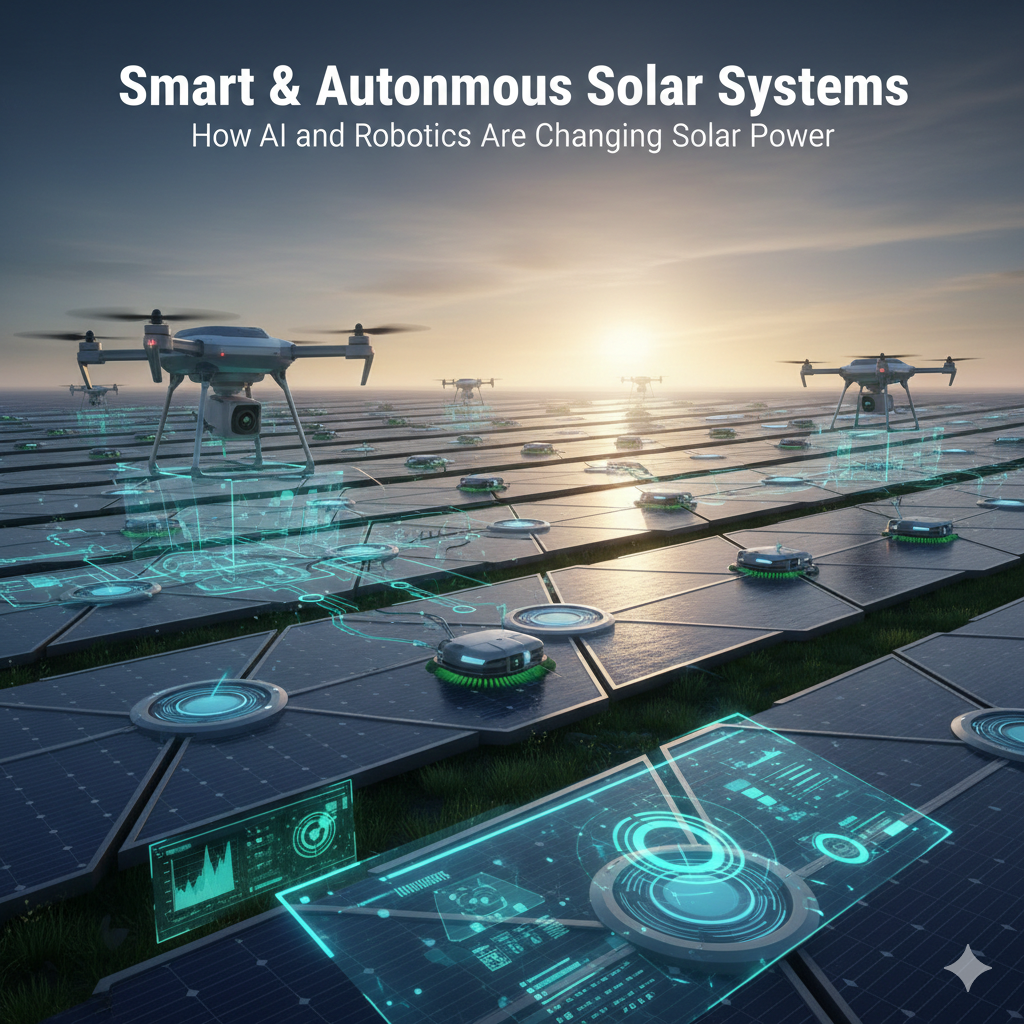
Robots are increasingly being deployed across solar installations to handle tasks that are repetitive, labour-intensive, dangerous, or costly when performed manually. Among these applications, robotic cleaning has emerged as one of the most commercially successful technologies.
Dust and soiling can reduce solar output by 5–30 percent depending on location. In desert regions, losses can exceed 40 percent if panels are not cleaned regularly. Manual cleaning requires large water volumes, skilled labour, and frequent site access, making it both expensive and environmentally challenging.
Robotic cleaning systems operate autonomously, often at night, using either dry brushes or minimal water technology. Controlled by AI algorithms, these robots clean panels only when performance loss justifies the operation. This ensures optimal cleaning frequency while reducing water consumption and mechanical wear.
In many installations, robotic cleaning alone has improved annual energy yield enough to recover investment costs within one to two years.
Robotic inspection and monitoring
Beyond cleaning, robotics plays an essential role in inspection and diagnostics. Drones equipped with thermal cameras and high-resolution imaging systems can inspect thousands of modules in a matter of hours. When combined with AI-based computer vision, these inspections become highly accurate.
AI algorithms analyse thermal images to detect hotspots, microcracks, diode failures, delamination, and shading issues that are invisible to the naked eye. Each detected anomaly is classified, mapped, and prioritised based on severity and potential energy loss.
This automated inspection process provides consistent quality, eliminates human subjectivity, and creates detailed historical records for long-term asset management.
Ground-based inspection robots and rooftop crawling robots are also emerging, particularly in commercial and industrial installations where access can be challenging.
Smart inverters and autonomous power control
Modern solar inverters have evolved into intelligent grid-interactive devices. Today’s smart inverters do far more than convert DC electricity into AC power. They actively manage voltage, frequency, reactive power, and grid stability.
When combined with AI control systems, inverters can dynamically adjust output based on grid conditions, energy prices, and on-site demand. This capability is critical as renewable penetration increases and grids become more complex.
Smart inverters also enable seamless integration with battery storage systems. AI algorithms determine optimal charging and discharging schedules based on solar forecasts, electricity tariffs, and consumption patterns. This allows solar power to be used when it delivers the highest economic and operational value.
Solar plus storage: intelligence beyond generation
Battery storage transforms solar from an intermittent resource into a dispatchable energy system. However, without intelligent control, batteries can degrade quickly or fail to deliver maximum financial returns.
AI-driven energy management systems monitor battery state of charge, temperature, cycle depth, and ageing behaviour. They optimise usage strategies to balance revenue generation with battery health preservation.
In commercial environments, this intelligence supports peak-shaving, demand-charge reduction, and backup power optimisation. In utility-scale projects, it enables grid stabilisation and frequency regulation services.
The combination of AI, solar, and storage is one of the strongest pillars of future renewable infrastructure.
Digital twins and simulation-based optimisation
An emerging advancement in smart solar technology is the use of digital twins. A digital twin is a virtual replica of a physical solar system that mirrors real-time operating conditions.
By simulating thousands of scenarios, digital twins allow operators to test configuration changes, maintenance strategies, and equipment upgrades before implementing them in the real world. This reduces operational risk and improves decision-making accuracy.
Digital twins also enable long-term performance forecasting, degradation modelling, and financial planning, making them invaluable tools for investors and operators alike.
Edge computing and decentralised intelligence
While cloud computing plays a vital role in solar analytics, many smart solar systems now utilise edge computing. Edge AI processes data locally at the solar site, enabling faster response times and reducing reliance on constant internet connectivity.
This is especially important for remote installations where communication delays can impact performance or safety. Edge intelligence allows trackers to respond instantly to wind gusts, enables robots to operate autonomously, and ensures continuous protection even during network outages.
The future of solar intelligence lies in hybrid architectures combining edge computing with cloud-based fleet management.
Cybersecurity and system reliability
As solar systems become more connected and autonomous, cybersecurity becomes a critical concern. Smart solar infrastructure must be protected against unauthorised access, data breaches, and operational manipulation.
Modern systems incorporate encrypted communication, secure authentication, network segmentation, and continuous vulnerability monitoring. Cybersecurity is no longer optional; it is a fundamental requirement of intelligent energy infrastructure.
Economic value of smart and autonomous solar systems
The financial benefits of smart solar technology extend far beyond efficiency gains. Increased uptime, reduced maintenance costs, longer component lifespan, improved forecasting accuracy, and better energy market participation all contribute to higher returns on investment.
Even modest performance improvements of 1–3 percent can translate into substantial revenue increases for large solar plants. When combined with automation and reduced labour dependency, intelligent systems consistently outperform traditional installations over their lifetime.
The future of solar power
The global transition to renewable energy requires solar systems that are not only clean, but also reliable, flexible, and intelligent. Smart & Autonomous Solar Systems represent the foundation of this future.
As AI algorithms mature, robotics becomes more advanced, and digital integration deepens, solar power plants will increasingly operate with minimal human involvement. Maintenance will become predictive, optimisation continuous, and performance self-correcting.
In the coming decade, solar energy will not simply be generated — it will be managed intelligently.
Final thoughts
Smart & Autonomous Solar Systems mark a turning point in renewable energy technology. By merging artificial intelligence, robotics, automation, and advanced analytics, solar power is evolving from a passive infrastructure asset into an intelligent energy ecosystem.
For homeowners, businesses, and utility-scale operators alike, this transformation delivers higher efficiency, lower costs, improved reliability, and long-term sustainability.
As solar adoption continues to accelerate worldwide, intelligence will define the difference between average performance and exceptional performance. The future of solar is not only renewable — it is autonomous, adaptive, and smart.
According to the International Energy Agency (IEA), solar PV is expected to become the world’s largest source of electricity, making intelligent and autonomous solar systems essential for grid stability and long-term energy reliability.
Also Read : Agrivoltaics: Growing Crops Under Solar Panels — The Future of Smart Farming