Introduction
For decades, solar energy has been associated with one major limitation — no sunlight means no electricity.
As soon as the sun sets, traditional solar panels stop producing power. Homes then rely on batteries, generators, or the electricity grid. But what if solar panels could generate electricity even at night?
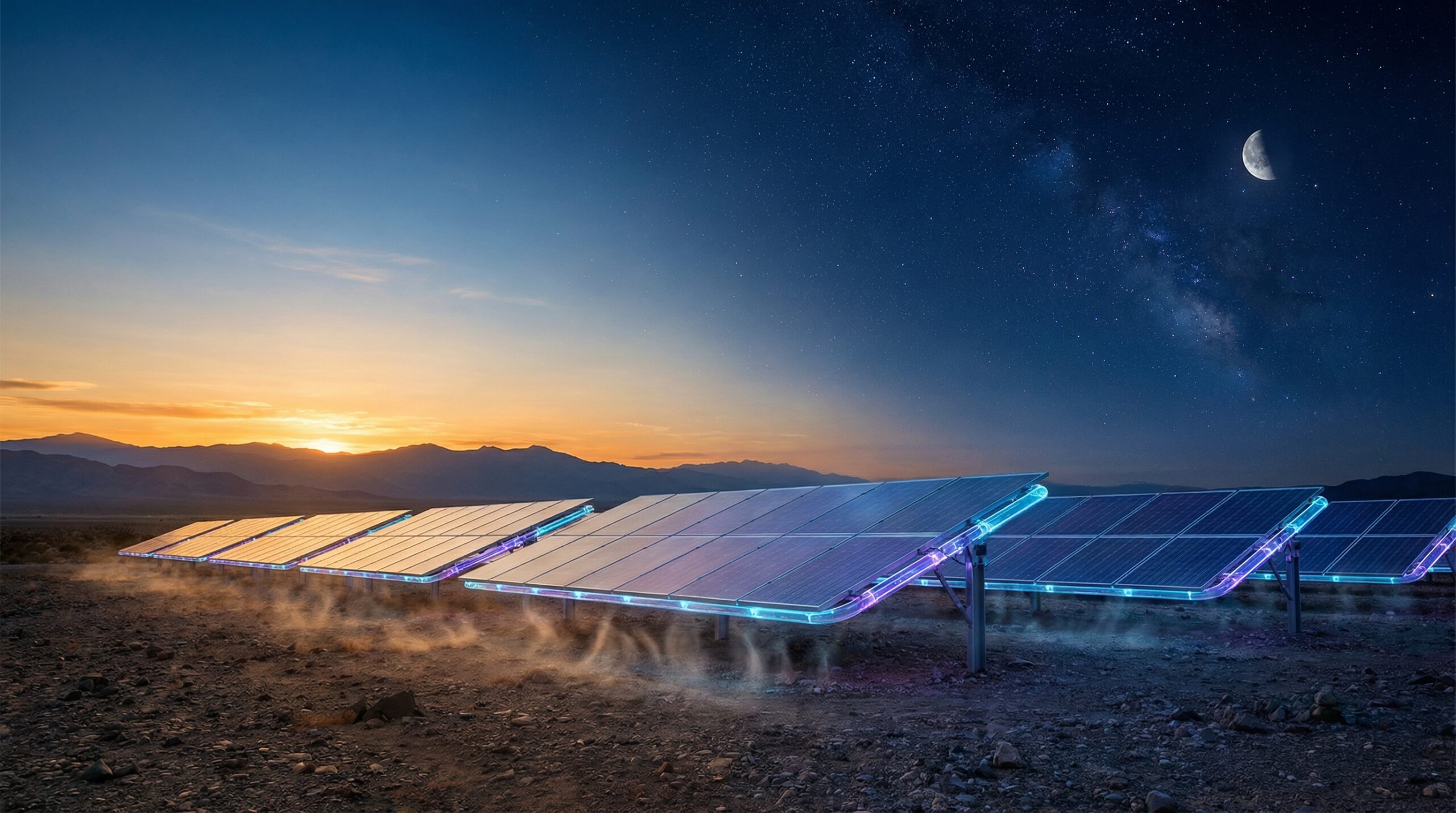
It may sound impossible, yet recent scientific breakthroughs suggest that solar panels working at night are becoming a real possibility.
This innovation has triggered massive global interest, with searches for “night solar panels”, “anti-solar panels”, and “solar power without sunlight” surging dramatically in the past week.
So the big question is:
Are solar panels that work at night the future of energy?
Let’s explore the science, technology, advantages, challenges, and future potential behind this revolutionary concept.
🌞 Why Traditional Solar Panels Stop Working at Night
Conventional solar panels rely on photovoltaic (PV) cells.
These cells generate electricity when:
- Sunlight hits the panel
- Photons excite electrons
- Electric current flows
Without sunlight:
- No photons
- No excited electrons
- No power generation
This is why solar systems currently depend on:
- 🔋 Battery storage
- ⚡ Grid connectivity
- 🛢 Backup generators
Although battery technology has improved, it still increases:
- Installation cost
- Maintenance complexity
- Environmental footprint
Hence, scientists began searching for a solution that could allow solar panels to operate after sunset.
🌙 What Are Solar Panels That Work at Night?
Night solar panels are often called:
- Anti-solar panels
- Thermal radiation panels
- Night-time photovoltaic devices
Unlike traditional panels, they do not rely on sunlight.
Instead, they generate electricity from:
The temperature difference between Earth and outer space.
Yes — even at night, energy is flowing.
🔬 The Science Behind Night Solar Technology
At night, the Earth continuously releases heat into space in the form of infrared radiation.
This process is called:
Radiative cooling
Here’s how night solar panels work:
- During the day, Earth absorbs solar heat
- At night, Earth emits that heat back into space
- This heat flow creates a temperature difference
- A special device captures that difference
- Electricity is generated using thermoelectric materials
In simple words:
Night solar panels work by releasing heat, not absorbing light.
⚙️ How Do Night Solar Panels Actually Generate Electricity?
The technology uses three key components:
1️⃣ Radiative Cooling Surface
A specially engineered surface sends infrared heat into space.
2️⃣ Thermoelectric Generator
It converts temperature differences into electrical current.
3️⃣ Cold Outer Space
Outer space acts as an infinite heat sink at nearly −270°C.
The temperature difference between:
- Warm Earth surface
- Extremely cold space
creates usable electrical energy — even in total darkness.
🔋 How Much Power Can Night Solar Panels Produce?
Currently, night solar panels generate:
- Around 25–50 milliwatts per square metre
This is much lower than daytime solar panels, which produce:
- 150–200 watts per square metre
However, experts emphasise that:
- This is early-stage technology
- Solar panels were also extremely inefficient in their early days
What matters is not current output — but scalability.
📈 Why This Technology Is Creating Global Buzz
Search interest exploded because night solar panels promise to solve solar energy’s biggest problem:
Intermittency
If solar works both day and night:
- Power becomes continuous
- Battery dependency reduces
- Grid pressure decreases
- Renewable reliability increases
This could fundamentally transform global energy systems.
🌍 Major Advantages of Solar Panels That Work at Night
✅ 1. 24×7 Clean Energy
Solar energy would no longer be limited to daylight hours.
This enables:
- Continuous electricity
- Lower storage demand
- Improved grid stability
✅ 2. Reduced Battery Dependency
Batteries are:
- Expensive
- Resource-intensive
- Environmentally challenging
Night solar reduces battery size requirements significantly.
✅ 3. Works in All Weather Conditions
Night panels can operate:
- Without sunlight
- During cloudy conditions
- In winter months
- Even in polar regions
✅ 4. Perfect Companion to Daytime Solar
Day solar + night solar together create a hybrid energy system.
This combination could deliver:
- Smoother power curves
- Higher utilisation rates
- Better ROI
✅ 5. Lower Carbon Footprint
Less storage means:
- Fewer lithium mines
- Reduced battery waste
- Lower lifecycle emissions
⚠️ Current Limitations and Challenges
Despite its promise, night solar technology faces challenges.
❌ 1. Low Power Output
At present, output is suitable only for:
- Sensors
- IoT devices
- Low-power electronics
Large-scale deployment requires efficiency breakthroughs.
❌ 2. High Manufacturing Costs
Specialised materials are still expensive.
Mass production is yet to begin.
❌ 3. Early Research Stage
Most systems are currently:
- Laboratory-tested
- Prototype-level
- Not commercially available
❌ 4. Integration Complexity
Combining night solar with existing infrastructure requires:
- Advanced controllers
- Smart grids
- AI-based energy management
🧠 Role of AI in Night Solar Systems
Artificial intelligence plays a major role in making night solar viable.
AI helps by:
- Predicting temperature gradients
- Switching between day and night generation
- Optimising thermal flow
- Managing hybrid energy systems
This AI–solar combination is becoming one of the most searched renewable topics globally.
🏠 Potential Applications of Night Solar Panels
🔹 Smart Homes
- Emergency night backup
- Reduced battery drain
🔹 Remote Areas
- Off-grid villages
- Mountain regions
🔹 Space & Defence
- Satellites
- Military sensors
🔹 Smart Cities
- Street lights
- Traffic sensors
- Monitoring systems
🌐 Can Night Solar Replace Traditional Solar?
Not replace — but complement.
Experts agree the future lies in:
Hybrid solar systems
- Daytime photovoltaic panels
- Night-time radiative panels
- Battery storage
- AI optimisation
Together, these systems can provide near-continuous renewable power.
🔮 Is This the Future of Energy?
Most energy experts believe:
✅ Night solar will not replace daytime solar
✅ But it will significantly enhance renewable reliability
Just like:
- Solar panels improved over decades
- Battery prices dropped 90%
- Efficiency tripled
Night solar technology is expected to follow a similar curve.
📊 Market Outlook (2026–2040)
Industry projections suggest:
- Prototype deployments by 2026–2028
- Commercial hybrid systems by 2030
- Large-scale adoption post-2035
As climate pressure grows, technologies enabling round-the-clock clean power will dominate investment.
🌱 Environmental Impact
If scaled successfully, night solar can:
- Reduce fossil fuel dependency
- Lower peak grid loads
- Cut emissions significantly
- Support net-zero goals
It could become one of the most important climate innovations of the next 20 years.
❓ Frequently Asked Questions (SEO Friendly)
Q1. Do solar panels really work at night?
Yes, new experimental technologies can generate electricity at night using thermal radiation instead of sunlight.
Q2. Are night solar panels available commercially?
Not yet. They are currently in research and prototype stages.
Q3. How much power can they produce?
Currently very small amounts, but efficiency is improving rapidly.
Q4. Will this replace batteries?
Not entirely, but it can significantly reduce battery dependency.
Q5. Is night solar better than traditional solar?
No — it works best alongside traditional solar panels.
🌟 Final Verdict
Solar panels that work at night represent one of the most exciting breakthroughs in renewable energy.
While still in early development, the technology has the potential to:
- Eliminate solar downtime
- Reduce battery dependence
- Deliver near-continuous clean electricity
- Transform global power infrastructure
The idea that electricity can be produced without sunlight was once unthinkable.
Today, it’s becoming reality.
🌙 The sun may set — but solar power doesn’t have to.
Also Read : Solar Panel Technology Comparison: Mono PERC vs TOPCon vs HJT