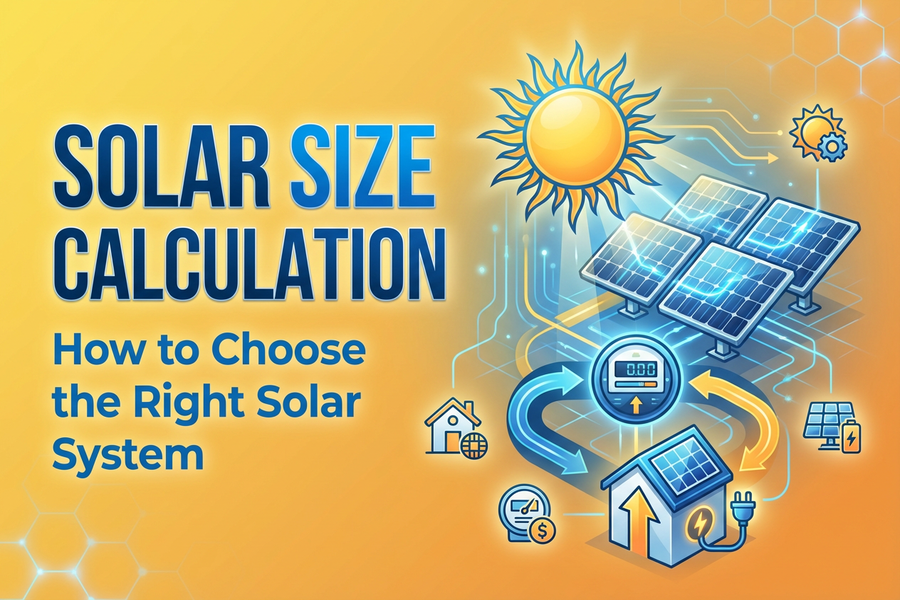
Choosing the correct solar capacity for your home is the most important step before installing a rooftop solar system. A properly sized system gives you the right amount of electricity, reduces your monthly bills, and avoids unnecessary spending. This is why solar size calculation is essential for every homeowner planning to switch to solar energy. With the right calculation, you can determine how much power you actually need and how many solar panels will work best for your home.
This complete guide explains how to calculate the correct solar size based on electricity usage, rooftop space, appliances, local weather, and future needs. Whether you want to reduce your electricity bill or run your entire home on solar, accurate solar size calculation ensures long-term savings and the best performance.
Start With Your Monthly Electricity Consumption
Your electricity bill is the first and most reliable source of information. It shows your total consumption in units (kWh). One unit equals one kilowatt-hour, which is the standard measure for solar calculations.
To begin:
- Check the last 6–12 months of electricity bills.
- Note your average monthly units.
This helps you understand your true power needs. For example:
- 150–200 units/month → Small home
- 250–400 units/month → Medium home
- 450–700 units/month → Large home
- 700+ units/month → Heavy consumption
Without analysing your electricity usage, no solar installer can recommend the correct system. That is why this step is the foundation of proper solar size calculation.
Convert Monthly Units to Daily Consumption
Solar panels generate power daily, so you must convert monthly usage into daily demand.
Formula:
Daily consumption = Monthly units ÷ 30
Examples:
- 300 units/month → 300 ÷ 30 = 10 units/day
- 450 units/month → 450 ÷ 30 = 15 units/day
- 600 units/month → 600 ÷ 30 = 20 units/day
Once you know your daily usage, you can match it with the output of a solar system.
Understand How Much Power a Solar System Generates
In India, a rooftop solar system generates 4 units per day per kW on average.
This is a standard reference used across the industry:
- 1 kW → 4 units/day
- 2 kW → 8 units/day
- 3 kW → 12 units/day
- 5 kW → 20 units/day
This makes solar size calculation extremely simple.
Use the Solar Size Calculation Formula
Now you can calculate the exact solar size needed for your home.
Formula:
Solar system size = Daily consumption ÷ 4
Examples:
- 10 units/day → 10 ÷ 4 = 2.5 kW system
- 15 units/day → 15 ÷ 4 = 3.75 kW system
- 20 units/day → 20 ÷ 4 = 5 kW system
Most Indian homes need 2 kW–5 kW, depending on their lifestyle.
Check Roof Space Before Finalising Size
Even if you calculate the perfect solar size, your rooftop must have enough shadow-free space for the panels.
General roof space requirement:
- 1 kW = 80–100 sq. ft.
- 2 kW = 160–200 sq. ft.
- 3 kW = 240–300 sq. ft.
- 5 kW = 400–500 sq. ft.
If your roof is small, you may need higher wattage monocrystalline panels to fit more power in less space.
This step is crucial because solar size calculation is meaningful only when your roof supports the chosen capacity.
Consider Your Appliance Load
Different homes use different appliances. High-power appliances consume more units and require larger solar systems.
Common high-load appliances include:
- Air conditioners (1–1.5 ton)
- Refrigerator
- Water pump
- Microwave
- Iron
- Geyser
- Washing machine
- Induction cooker
Example:
- Home with 1 AC → 3 kW–5 kW system
- Home with 2 ACs → 5 kW–8 kW system
- Home without AC → 1 kW–2 kW
Your appliance list directly impacts your solar size calculation.
Account for Future Power Needs
Your electricity usage may increase over time. You might add:
- A new AC
- A bigger fridge
- More appliances
- An EV charger
To avoid upgrading your solar system later, add 0.5 kW to 1 kW extra to your calculated solar size.
Example:
If your ideal size is 3 kW, you can install 3.5–4 kW for future-ready performance.
Consider Weather and Sunlight in Your Region
India has different sunlight patterns:
- Rajasthan, Gujarat → High sunlight
- Delhi, Haryana, UP → Moderate sunlight
- Kerala, WB, Northeast → Lower sunlight
If your city gets less sunlight, increase your solar size slightly.
Example:
15 units/day usage → normally 3.75 kW
In low-sunlight areas: 4 kW–4.5 kW
Regional climate plays an important role in accurate solar size calculation.
Choose the Right Type of Solar System
Your solar size also depends on whether you choose:
On-Grid System
- Best for reducing electricity bills
- No batteries
- Ideal for cities and towns
Off-Grid System
- Works in areas with power cuts
- Requires batteries
- Needs slightly higher solar capacity
Hybrid System
- Combines backup + grid export
- Most expensive but most reliable
For example:
A home needing 3 kW on-grid may need 4 kW off-grid because battery charging needs more capacity.
Always ensure the panels and inverters you choose are approved by the Ministry of New and Renewable Energy (MNRE) for safety and performance:
Calculate the Number of Solar Panels
Modern solar panels come in 400W to 550W capacities.
To find the number of panels:
Number of panels = Total system size (W) ÷ Panel wattage (W)
Example for 3 kW (3000W) using 500W panels:
3000 ÷ 500 = 6 panels
Example for 5 kW:
5000 ÷ 500 = 10 panels
This step completes the technical side of solar size calculation.
Estimate Your Savings Based on Correct Solar Size
Your savings depend on accurate sizing.
- 2 kW system → ₹1,200–₹2,000/month
- 3 kW system → ₹2,000–₹3,500/month
- 5 kW system → ₹3,500–₹6,000/month
With the right solar size, your payback period becomes shorter, usually 3–5 years, especially with government subsidies.
Conclusion
Accurate solar size calculation is the key to installing the perfect solar system for your home. By analysing your electricity consumption, calculating daily usage, checking roof space, understanding appliance loads, and planning for future needs, you can choose the ideal solar size that gives maximum savings and long-term performance. A correctly sized system ensures efficient power generation, shorter payback periods, and reliable energy for the next 25 years.
Switching to solar is one of the smartest decisions today, and choosing the right solar system size makes the decision even more powerful.
Also Read : On-Grid vs Off-Grid vs Hybrid Solar: Which System Is Best for You?