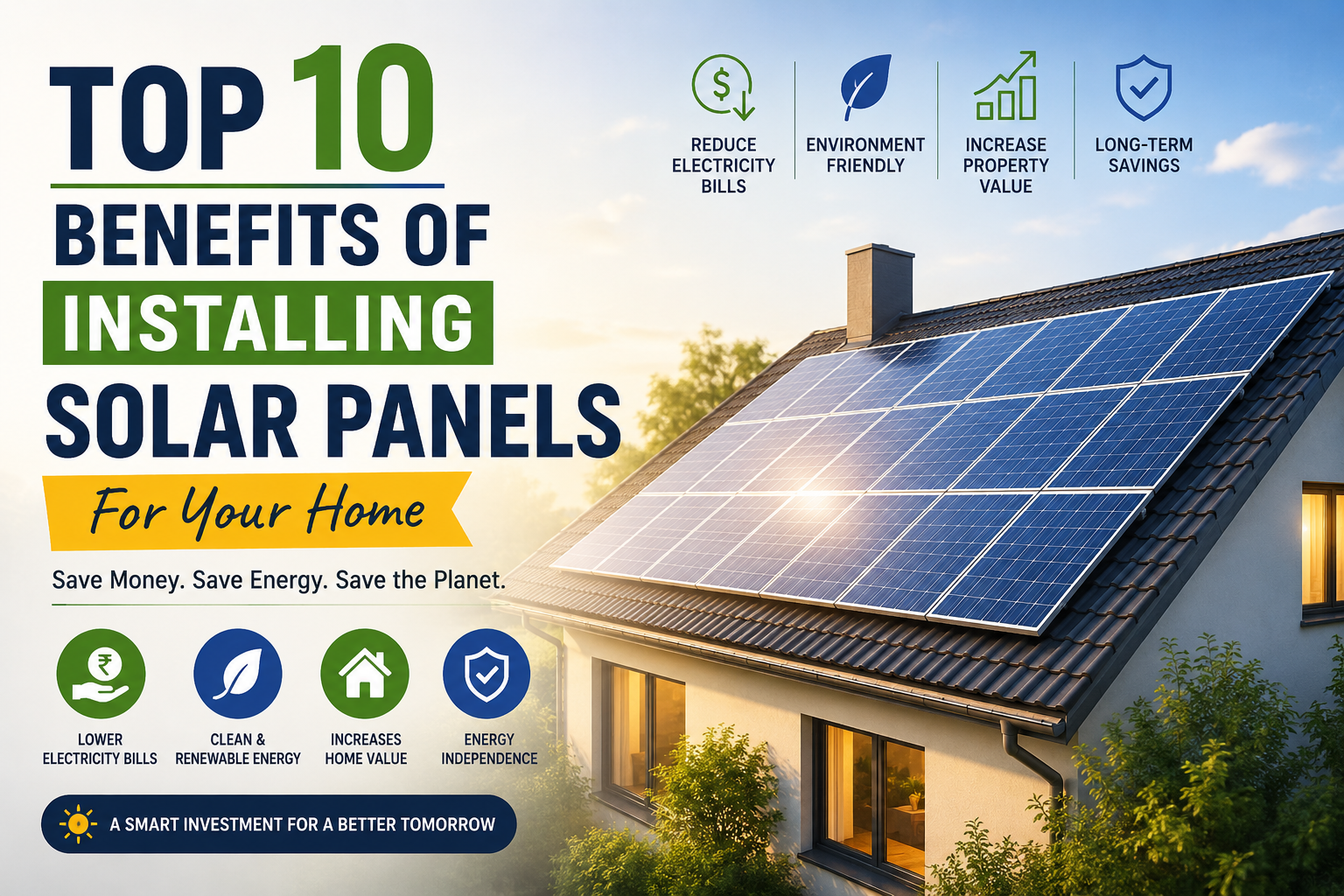
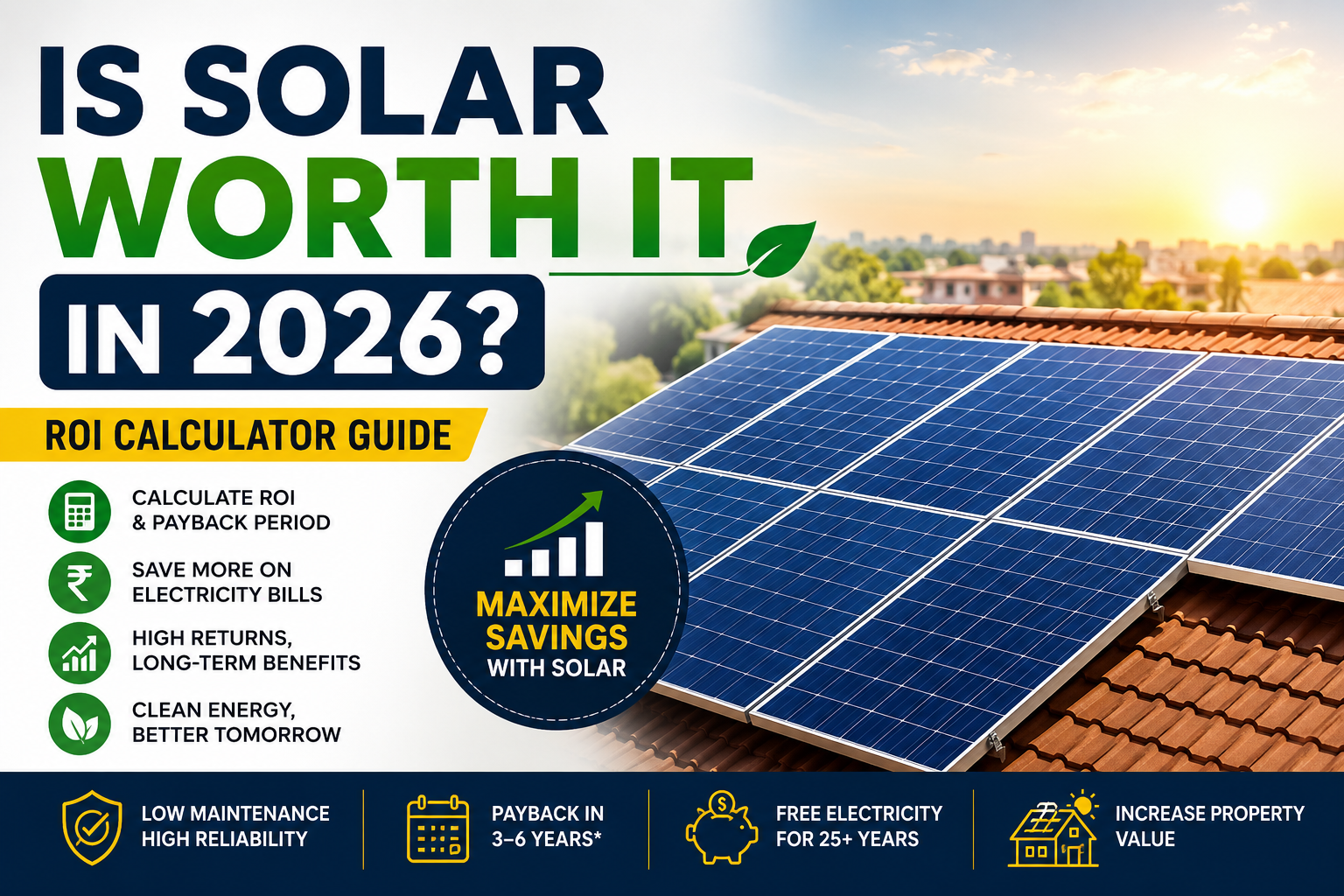
Electricity prices keep rising, businesses are searching for cost-saving solutions, and homeowners want long-term savings. Because of this, one question is becoming more common than ever: Is solar worth it in 2026?
The short answer is yes. For most Indian households and commercial properties, solar power is now one of the smartest long-term investments available. However, the actual return depends on several factors, including electricity usage, location, solar panel quality, rooftop space, subsidies, and system size.
Many people assume solar is expensive. Others believe the savings take too long to recover the investment. Some think solar panels stop working during cloudy weather or become useless after a few years. These assumptions often prevent good decisions.
The reality is different.
Modern solar systems are more efficient, installation costs are lower than previous years, financing options are easier, and government support has made adoption faster. In many cases, homeowners recover their investment within a few years and continue enjoying free electricity for decades.
This guide explains everything in practical terms. You will understand the cost, expected savings, ROI formula, hidden factors, and how to calculate your return before making a decision.
If you have been wondering whether solar makes financial sense in 2026, this guide will help you calculate the answer.
Understanding Solar ROI in Simple Terms
Before deciding if solar is worth it, you need to understand what ROI means.
ROI stands for Return on Investment.
In simple language, it measures how much money you save compared to how much money you spend.
For solar, ROI answers one key question:
If I spend money on installing solar panels today, how much money will I save over time?
The calculation is simple:
Solar ROI = (Total Savings – Total Investment) ÷ Total Investment × 100
Example:
If you install a solar system for ₹3,00,000 and save ₹9,00,000 over its lifetime:
ROI = (₹9,00,000 – ₹3,00,000) ÷ ₹3,00,000 × 100
ROI = 200%
That means your investment generated three times its original value.
This is why solar is considered a strong long-term asset rather than just an expense.
Why Solar Makes More Sense in 2026
Solar adoption has increased dramatically because several factors have changed.
Electricity Costs Keep Increasing
Traditional electricity tariffs continue rising.
Monthly power bills for homes and businesses have become a major expense. Commercial users especially feel this pressure because higher units mean higher tariffs.
When grid electricity becomes expensive, solar becomes more attractive.
A solar system protects you from future price increases.
Instead of depending entirely on utility rates, you generate your own electricity.
This creates predictable long-term savings.
Better Technology
Older solar systems were less efficient.
Modern panels generate more electricity using less roof space.
This means homeowners can achieve better output without requiring large installation areas.
New inverters are smarter, batteries are improving, and system monitoring has become easier.
Better technology directly improves ROI.
Government Support
Subsidies significantly reduce upfront costs.
When installation costs decrease, the payback period becomes shorter.
This improves overall profitability.
Government initiatives in India have made rooftop solar more accessible.
Financing Options
Many users no longer need to pay the entire amount upfront.
EMI plans and solar financing have made installation easier.
When monthly EMI is lower than your electricity bill savings, solar becomes financially attractive almost immediately.
Rising Environmental Awareness
Consumers and businesses increasingly value sustainable solutions.
Solar helps reduce carbon emissions while lowering energy expenses.
This creates both financial and environmental benefits.
Solar ROI Calculator: How to Calculate Your Savings
To know if solar is worth it, calculate your expected savings.
Here is a practical solar ROI calculator formula.
You need five numbers:
- Current monthly electricity bill
- Annual electricity consumption
- Solar installation cost
- Government subsidy
- Expected annual savings
Formula:
Net Solar Cost = Installation Cost – Subsidy
Annual Savings = Monthly Bill Savings × 12
Payback Period = Net Cost ÷ Annual Savings
Lifetime Profit = Total Savings Over 25 Years – Net Cost
Example:
Monthly electricity bill: ₹8,000
Annual electricity cost:
₹8,000 × 12 = ₹96,000
Solar system cost:
₹4,50,000
Government subsidy:
₹78,000
Net cost:
₹4,50,000 – ₹78,000 = ₹3,72,000
Annual savings:
₹90,000
Payback period:
₹3,72,000 ÷ ₹90,000 = 4.1 years
Lifetime savings over 25 years:
₹90,000 × 25 = ₹22,50,000
Lifetime profit:
₹22,50,000 – ₹3,72,000 = ₹18,78,000
This is why many people consider solar one of the best long-term investments.
Average Solar Installation Cost in India in 2026
Costs vary depending on system size and product quality.
Estimated residential pricing:
1kW Solar System
₹70,000 to ₹95,000
2kW Solar System
₹1,40,000 to ₹1,80,000
3kW Solar System
₹1,90,000 to ₹2,70,000
5kW Solar System
₹3,20,000 to ₹4,80,000
10kW Solar System
₹6,50,000 to ₹9,00,000
Commercial installations may differ depending on scale.
Factors affecting pricing:
- Solar panel brand
- Inverter type
- Mounting structure
- Installation complexity
- Roof type
- Labour charges
- Monitoring systems
- Battery inclusion
Battery systems increase costs significantly.
Grid-connected systems usually deliver faster ROI because they are cheaper.
How Much Can Solar Save Every Month?
Savings depend on energy consumption.
Typical examples:
Small Household
Monthly bill: ₹3,000
Estimated solar savings:
₹2,200 to ₹2,800 monthly
Annual savings:
₹26,400 to ₹33,600
Medium Household
Monthly bill: ₹7,000
Estimated savings:
₹5,500 to ₹6,800 monthly
Annual savings:
₹66,000 to ₹81,600
Large Household
Monthly bill: ₹15,000
Estimated savings:
₹11,000 to ₹14,000 monthly
Annual savings:
₹1,32,000 to ₹1,68,000
Commercial Property
Monthly bill: ₹80,000
Estimated solar savings:
₹55,000 to ₹75,000 monthly
Annual savings:
₹6.6 lakh to ₹9 lakh
Commercial users often see faster returns because electricity tariffs are higher.
Solar Payback Period in 2026
Payback period means how long it takes to recover your investment.
Typical timelines:
Residential:
4 to 7 years
Commercial:
3 to 5 years
Industrial:
2.5 to 5 years
Systems with batteries:
Longer payback due to higher costs
Better sunlight exposure improves payback.
Higher electricity rates improve payback.
Poor system design slows returns.
Hidden Factors That Affect ROI
Many calculators ignore important variables.
Roof Direction
South-facing roofs generally perform better.
Poor orientation reduces efficiency.
Shade
Trees, nearby buildings, water tanks, and shadows reduce output.
Less output means lower savings.
Panel Quality
Cheap panels may degrade faster.
High-quality systems often deliver better lifetime ROI.
Maintenance
Solar maintenance is relatively low.
However, cleaning and periodic servicing matter.
Dirty panels produce less electricity.
Inverter Replacement
Inverters may need replacement during system life.
Include this in long-term calculations.
Battery Costs
Battery systems cost more.
Unless backup power is essential, batteries may reduce short-term ROI.
Is Solar Better Than Traditional Investments?
Compare solar with common investments.
Fixed deposits:
6% to 8% average annual returns
Mutual funds:
Variable returns
Real estate:
High capital requirement
Gold:
Price volatility
Solar:
Predictable electricity savings
Inflation protection
Long asset life
Low maintenance
For many property owners, solar behaves like a guaranteed return asset.
Instead of earning market returns, you reduce unavoidable expenses.
That makes solar financially attractive.
Common Myths That Stop People From Going Solar
Myth 1: Solar Is Too Expensive
Reality:
Upfront cost exists, but savings often recover investment quickly.
Myth 2: Solar Does Not Work in Cloudy Weather
Reality:
Solar works with reduced efficiency, not zero output.
Myth 3: Maintenance Is Difficult
Reality:
Maintenance is minimal.
Cleaning is usually enough.
Myth 4: Solar Panels Stop Working Quickly
Reality:
Modern systems often last 25 years or more.
Myth 5: ROI Is Too Slow
Reality:
Many users recover investment in under 5 years.
Who Benefits Most from Solar?
Solar works best for:
- High electricity bill households
- Independent homes
- Villas
- Schools
- Hospitals
- Hotels
- Factories
- Warehouses
- Offices
- Commercial buildings
Best ROI usually comes from heavy energy users.
Quick Self-Check Before Buying Solar
Ask yourself:
Do I pay high electricity bills?
Do I have usable rooftop space?
Will I stay in this property long-term?
Do I want predictable electricity costs?
Do I want lower carbon impact?
If most answers are yes, solar likely makes sense
To check the latest rooftop solar subsidy eligibility and application process, visit the official PM Surya Ghar
Also Read :- India Becomes the World’s 3rd-Largest Renewable Energy Power