
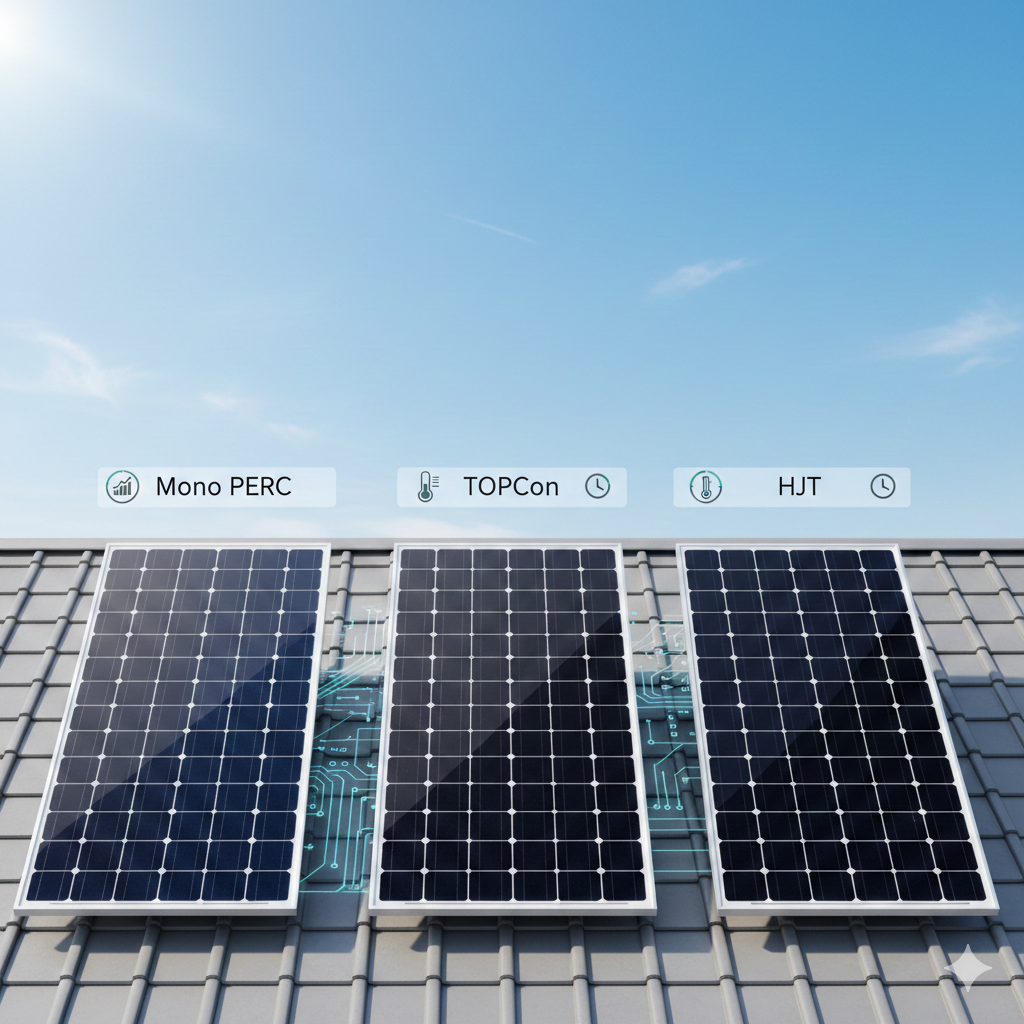
Choosing the right solar panel is no longer just about wattage or price. With rapid innovation in photovoltaic engineering, today’s buyers must understand the solar panel technology comparison between Mono PERC, TOPCon, and HJT before making a long-term investment.
Although all three technologies are based on monocrystalline silicon, their internal structures, efficiency behaviour, degradation rates, and real-world performance differ significantly. These differences directly affect how much electricity your system produces over 25 to 30 years.
This detailed solar panel technology comparison by SolarXNest explains how Mono PERC, TOPCon and HJT panels work, how they perform under real conditions, and which technology offers the best value for modern solar installations.
According to the International Energy Agency (IEA), advanced solar cell technologies such as TOPCon and HJT are expected to dominate new photovoltaic manufacturing capacity worldwide over the next decade.
Understanding Solar Panel Technology Evolution
The photovoltaic industry has evolved rapidly over the past decade. Early solar installations relied heavily on polycrystalline panels, which offered affordability but suffered from low efficiency and higher degradation.
The transition to monocrystalline silicon marked the beginning of high-efficiency solar systems. As energy demand increased and roof space became limited, manufacturers began developing advanced cell architectures to extract more electricity from the same surface area.
This innovation journey led to three dominant technologies used today:
- Mono PERC
- TOPCon
- HJT
A proper solar panel technology comparison must examine how each of these designs improves upon the previous generation.
Mono PERC Solar Panel Technology Explained
Mono PERC stands for Monocrystalline Passivated Emitter and Rear Cell. It was developed as an upgrade to traditional monocrystalline solar panels.
In standard mono panels, some sunlight passes through the silicon wafer without being converted into electricity. Mono PERC technology reduces this loss by adding a reflective passivation layer on the rear side of the cell.
This layer reflects unused photons back into the silicon, increasing energy absorption.
Key Features of Mono PERC Technology
- Efficiency between 19.5% and 21.5%
- Widely available across markets
- Lower manufacturing cost
- Proven reliability
- Suitable for residential rooftops
For several years, mono PERC dominated global solar installations and became the industry standard.
Limitations Identified in Mono PERC Panels
Despite its popularity, mono PERC has technological limitations that have become more visible with large-scale deployment.
These include:
- Higher temperature sensitivity
- Light-Induced Degradation (LID)
- LeTID performance losses
- Faster long-term degradation
- Lower bifacial capability
In hot climates, mono PERC panels experience noticeable output drops during peak summer hours, reducing annual generation.
These limitations accelerated the development of next-generation technologies, leading to TOPCon and HJT.
TOPCon Solar Panel Technology Overview
TOPCon stands for Tunnel Oxide Passivated Contact. It is widely regarded as the most important advancement after Mono PERC.
In this solar panel technology comparison, TOPCon represents a major efficiency breakthrough without radically increasing production costs.
TOPCon cells use:
- An ultra-thin tunnel oxide layer
- A doped polycrystalline silicon contact
This design drastically reduces electron recombination, which is one of the biggest causes of power loss in solar cells.
Why TOPCon Technology Is Gaining Market Share
TOPCon solar panels offer several advantages:
- Higher cell efficiency
- Lower degradation rate
- Improved low-light performance
- Better temperature coefficient
- Excellent bifacial response
Most importantly, manufacturers can upgrade Mono PERC production lines to TOPCon with limited changes, enabling rapid global adoption.
As a result, TOPCon panels are becoming the new industry standard.
HJT Solar Panel Technology Explained
HJT, or Heterojunction Technology, represents the most advanced commercial solar cell design available today.
Unlike mono PERC and TOPCon, HJT combines:
- Crystalline silicon wafers
- Ultra-thin amorphous silicon layers
This hybrid structure provides exceptional surface passivation, allowing electrons to move with minimal resistance.
Because HJT cells are manufactured at lower temperatures, they experience less thermal stress and improved structural stability.
Why HJT Is Considered Premium Technology
In every serious solar panel technology comparison, HJT stands at the top in terms of performance metrics.
HJT panels provide:
- Extremely low degradation
- Outstanding temperature resistance
- Superior low-light generation
- Very high bifacial gain
- Long-term energy stability
These benefits make HJT the preferred technology for premium residential, commercial, and utility-scale projects.
Solar Panel Technology Comparison: Efficiency
Efficiency determines how much electricity can be generated from limited roof space.
| Technology | Module Efficiency |
|---|---|
| Mono PERC | 19.5% – 21.5% |
| TOPCon | 21.5% – 23% |
| HJT | 22% – 24% |
In real installations, even a 1% efficiency increase can result in hundreds of additional units annually.
For space-constrained rooftops, efficiency becomes a decisive factor in the solar panel technology comparison.
Temperature Performance Comparison
Solar panels lose efficiency as temperature increases.
| Technology | Temperature Coefficient |
|---|---|
| Mono PERC | −0.35% to −0.38% / °C |
| TOPCon | −0.30%/°C |
| HJT | −0.24% to −0.26% / °C |
This means HJT panels lose significantly less power on hot afternoons compared to Mono PERC.
In tropical and desert regions, this difference can improve annual energy output by 6–10%.
Degradation Rate Comparison
Degradation determines how much power a panel retains over time.
| Technology | Annual Degradation |
|---|---|
| Mono PERC | ~0.55% |
| TOPCon | ~0.40% |
| HJT | ~0.25% |
After 25 years:
- Mono PERC retains ~84–85%
- TOPCon retains ~88–89%
- HJT retains ~92–93%
Lower degradation significantly improves lifetime return on investment.
Real-World Energy Yield Comparison
A proper solar panel technology comparison must focus on total lifetime energy, not just wattage.
Average results show:
- TOPCon generates 3–5% more energy than Mono PERC
- HJT generates 6–10% more energy than Mono PERC
These gains result from:
- Higher efficiency
- Better heat resistance
- Improved morning and evening output
- Lower degradation
Over 25 years, this difference equals thousands of extra kilowatt-hours.
Cost Comparison of Solar Technologies
| Technology | Relative Cost |
|---|---|
| Mono PERC | Lowest |
| TOPCon | 5–10% higher |
| HJT | 15–25% higher |
While mono PERC appears cheaper initially, long-term energy output often favours TOPCon and HJT.
When evaluated using Levelised Cost of Electricity (LCOE), TOPCon frequently offers the best value.
Climate Suitability Comparison
- Hot regions: HJT performs best
- Moderate climates: TOPCon excels
- Budget installations: Mono PERC remains viable
- Limited roof area: TOPCon and HJT preferred
Climate plays a critical role in selecting the correct technology.
Bifacial Performance Comparison
| Technology | Bifacial Gain |
|---|---|
| Mono PERC | 5–10% |
| TOPCon | 10–20% |
| HJT | 20–30% |
As reflective rooftops and elevated mounting increase, bifacial capability becomes increasingly important.
Manufacturing Trends and Industry Direction
Global solar manufacturing data shows:
- Mono PERC capacity declining
- TOPCon expanding rapidly
- HJT growing in premium segments
This confirms that the future of solar lies beyond Mono PERC technology.
Which Solar Technology Is Best for You?
Choose Mono PERC if:
- The budget is limited
- The roof area is large
- Short-term ROI is prioritised
Choose TOPCon if:
- Long-term performance matters
- Balanced cost and efficiency is desired
- Installation is planned for 25+ years
Choose HJT if:
- Maximum efficiency is required
- The climate is hot
- Roof space is limited
- Premium quality is preferred
Final Verdict – SolarXNest Recommendation
This detailed solar panel technology comparison clearly shows that while Mono PERC played a crucial role in solar adoption, its limitations are becoming evident.
TOPCon represents the most balanced technology today, offering high efficiency, low degradation, and excellent affordability.
HJT stands at the peak of solar innovation, delivering unmatched stability and lifetime output.
For most modern installations, TOPCon is the smartest long-term choice, while HJT offers the highest performance available today.
About SolarXNest
SolarXNest is dedicated to simplifying solar technology through transparent analysis, real performance data, and expert insights—helping homeowners and businesses transition confidently toward clean energy.
Also Read: Top Solar Technologies 2025: TOPCon, N-Type & Bifacial Explained