India’s renewable energy journey is entering a powerful new phase. Over the last decade, solar power has grown rapidly across the country, with massive solar parks, rooftop installations, and government-backed initiatives pushing adoption at every level. However, despite this impressive growth, one major problem continues to limit the true potential of solar energy the inability to store it efficiently.
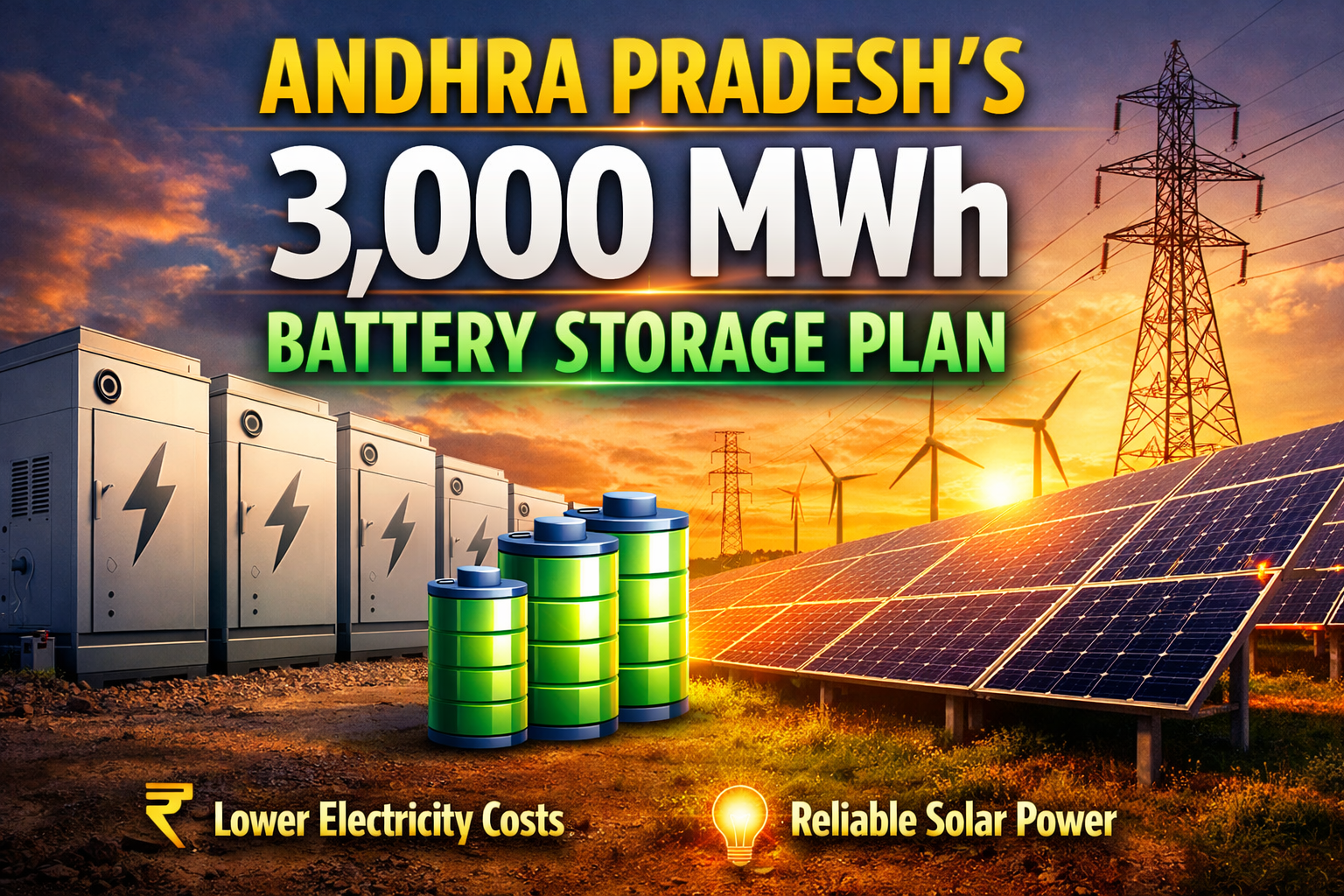
This is exactly where Andhra Pradesh’s ambitious plan to develop a 3,000 MWh Battery Energy Storage System (BESS) becomes a game changer. The state government has taken a bold step toward solving one of the biggest challenges in renewable energy: how to make solar power available even when the sun is not shining.
The idea behind this project is simple yet transformative. Solar energy is generated in abundance during the daytime, but electricity demand often peaks in the evening. Without storage, this excess daytime energy goes to waste, and power companies are forced to rely on expensive and polluting thermal sources. By introducing large-scale battery storage, Andhra Pradesh aims to bridge this gap and create a more balanced, efficient, and cost-effective power system.
The project plans to install battery systems with a total capacity of 3,000 megawatt-hours. In the first phase, around 1,000 MWh is expected to be completed by early 2027, with the remaining capacity added in subsequent phases. This phased approach allows the state to gradually scale its infrastructure while integrating advanced energy management systems.
To understand why this project matters so much, it’s important to first understand how battery energy storage works in the context of solar power. During the day, solar panels generate electricity, often more than what is immediately required. Instead of letting this excess energy go unused, it can be stored in batteries. Later, when demand increases — typically in the evening or at night — the stored energy is released back into the grid. This ensures a steady and reliable power supply without depending on fossil fuels.
This simple shift has far-reaching implications. One of the most significant benefits is the reduction in electricity costs. Currently, during peak demand hours, power distribution companies often purchase electricity at very high rates, sometimes reaching around ₹10 per unit. With battery storage, this cost can drop dramatically to approximately ₹4.85 per unit. Over time, this reduction translates into savings of hundreds of crores annually, improving the financial health of power companies and potentially lowering electricity bills for consumers.
Beyond cost savings, the project also addresses the issue of energy wastage. In many parts of India, solar energy production exceeds demand during certain hours of the day. Without storage, this surplus power is either curtailed or wasted. Battery systems ensure that every unit of energy generated is utilized effectively, increasing the overall efficiency of solar investments.
Another important impact is improved reliability of the power supply. Frequent power fluctuations and outages are still a concern in many regions. By stabilizing the grid and providing backup during peak hours, battery storage systems can significantly enhance power quality. This is particularly beneficial for industries, hospitals, and households that depend on uninterrupted electricity.
At the same time, the environmental benefits cannot be ignored. India still relies heavily on coal-based power generation to meet its energy needs, especially during peak hours. By reducing the need for thermal power, battery storage helps lower carbon emissions and supports the country’s climate goals. It also aligns with India’s broader vision of achieving a cleaner and more sustainable energy mix.
The implementation of this project will involve a combination of government support and private sector participation. Large-scale energy projects require significant investment, and collaboration between public and private players ensures faster execution and better resource management. The government is expected to provide policy support and incentives, while private companies will bring in technology and operational expertise.
This initiative also signals a major shift in how energy infrastructure is being planned in India. Earlier, the focus was primarily on increasing generation capacity. Now, the emphasis is equally on storage, distribution, and efficiency. This integrated approach is essential for building a resilient and future-ready energy system.
For the solar industry, this development opens up a wide range of opportunities. As battery storage becomes more common, the demand for advanced energy solutions will grow rapidly. This includes everything from battery manufacturing and installation to software systems that manage energy flow. Businesses that adapt to this trend early are likely to benefit the most.
From a consumer perspective, the impact will be equally significant. In the coming years, we may see more households adopting solar systems combined with battery storage. This combination allows users to generate their own electricity, store it, and use it whenever needed. The result is greater energy independence and lower reliance on the grid.
Digital marketers and content creators can also take advantage of this growing trend. Topics like “zero electricity bill,” “solar with battery cost,” and “future of renewable energy in India” are gaining massive traction online. As awareness increases, more people are actively searching for solutions that can help them reduce their energy costs and carbon footprint.
While the benefits are clear, it’s also important to acknowledge the challenges associated with battery storage projects. One of the biggest hurdles is the high initial investment. Although costs are decreasing over time, large-scale battery systems still require significant capital. Additionally, there are technical considerations such as battery lifespan, efficiency, and recycling.
Infrastructure readiness is another critical factor. Integrating battery storage into the existing grid requires advanced systems and careful planning. However, with continuous technological advancements and strong policy support, these challenges are gradually being addressed.
Looking ahead, the future of energy in India is likely to be shaped by the combination of solar power and battery storage. This model not only ensures reliability but also makes renewable energy more practical and accessible. Andhra Pradesh’s initiative is a strong step in this direction and could serve as a blueprint for other states.
As more regions adopt similar strategies, India will move closer to achieving round-the-clock renewable energy supply. This is essential for supporting economic growth while minimizing environmental impact. The transition may take time, but the foundation is already being laid through projects like this.
In conclusion, the 3,000 MWh battery storage plan is more than just an infrastructure project. It represents a shift in mindset — from simply generating energy to managing it intelligently. By addressing the core limitations of solar power, it unlocks new possibilities for efficiency, affordability, and sustainability.
The message is clear: the future of energy is not just about producing more power, but about using it smarter. With initiatives like this, India is moving steadily toward a cleaner, more reliable, and more efficient energy ecosystem.
And for anyone looking to enter the solar or energy space — whether as a business owner, marketer, or content creator — this is the perfect time to get started. The growth potential is massive, the demand is rising, and the opportunities are just beginning to unfold.
Also Read : Solar Traffic Signal Sheds in Nagpur: A Smart Urban Innovation for a Sustainable Future