
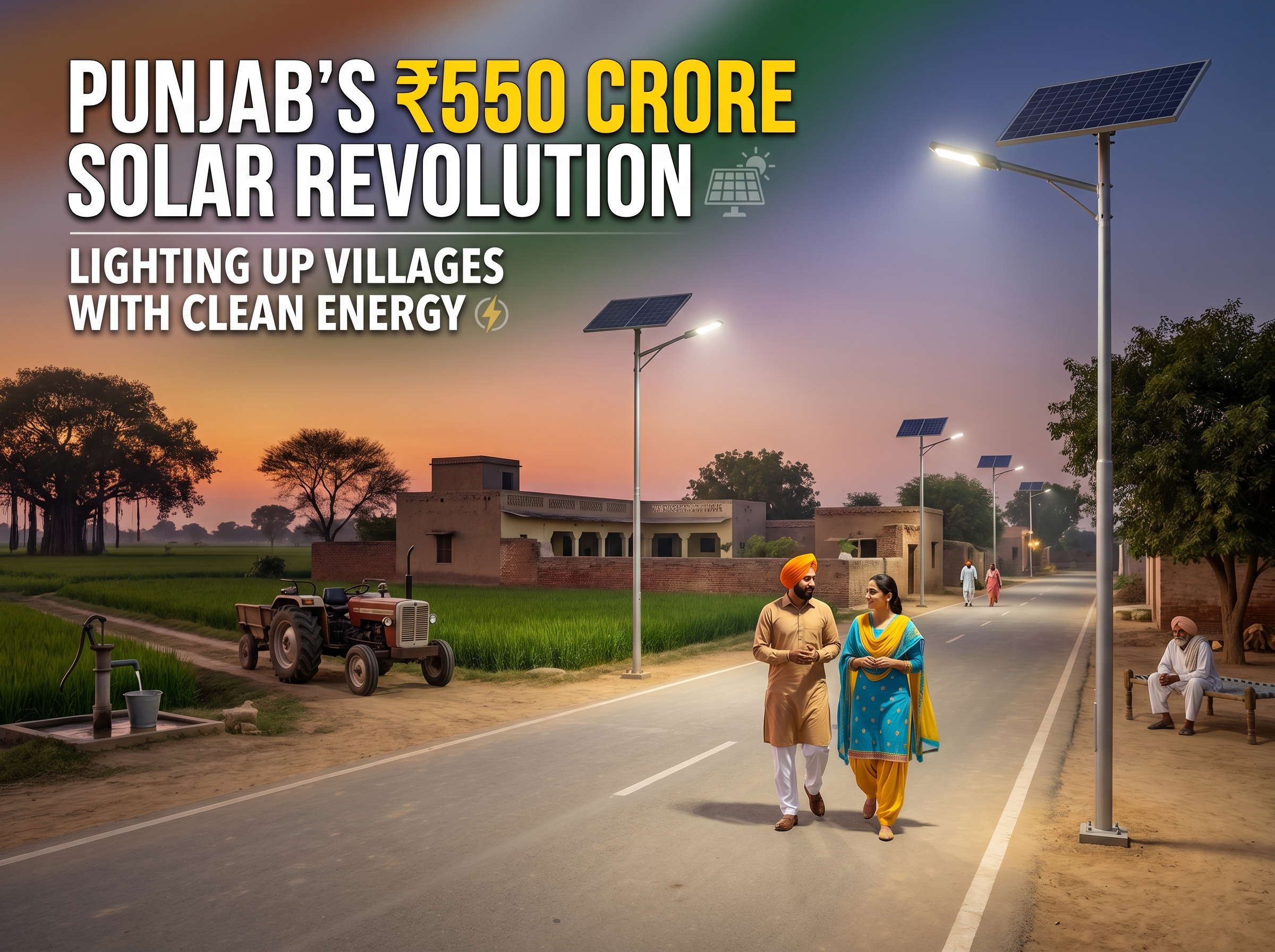
India is rapidly moving towards renewable energy, and states are increasingly adopting sustainable solutions to improve infrastructure and quality of life. One of the most significant recent developments in this direction is Punjab’s ₹550 crore solar LED streetlight scheme for villages. This ambitious initiative aims to transform rural living conditions, enhance safety, and promote economic growth through clean energy solutions.
The Punjab government has launched the “Mukhya Mantri Roshan Punjab Yojana”, a large-scale rural lighting program designed to install more than three lakh solar LED streetlights across thousands of villages. This initiative is not just about lighting up roads; it represents a broader vision of sustainable rural development powered by renewable energy.
According to recent reports, the scheme has been approved by the state cabinet and will be implemented in phases from June to October 2026. The program will be executed by the Punjab Energy Development Agency (PEDA), which has extensive experience in renewable energy projects.
This blog explores the scheme in detail, its benefits, implementation strategy, impact on rural life, and why it is a major milestone in India’s solar journey.
For deeper insights into India’s renewable energy growth and policies, visit the Ministry of New and Renewable Energy official website:
Understanding the Vision Behind the Scheme
The primary goal of this solar streetlight initiative is to provide reliable and cost-effective lighting in rural areas. For decades, many villages in Punjab have struggled with inadequate or non-functional street lighting systems. Traditional streetlights either depend on unreliable electricity supply or become non-operational due to poor maintenance.
In fact, over the past 70 years, only about 1.14 lakh streetlights were installed in Punjab’s villages, many of which are no longer functional. This clearly highlights the need for a modern, sustainable solution.
The new solar LED streetlight scheme addresses these issues by introducing a decentralized energy model. Unlike traditional lighting systems, solar lights operate independently of the power grid. They generate energy during the day and store it in batteries for use at night.
This makes them ideal for rural areas where electricity supply can be inconsistent.
Key Features of the Solar Streetlight Scheme
One of the reasons this scheme is gaining attention is its well-planned structure and modern features.
The government plans to install over three lakh solar LED streetlights across approximately 11,500 to 13,000 villages in Punjab. This makes it one of the largest rural lighting projects in India.
The financial model is also noteworthy. The scheme follows a 70:30 funding pattern, where 70% of the cost is covered by the state government, and the remaining 30% is contributed by gram panchayats. This reduces the financial burden on local bodies while ensuring community participation.
Another major feature is the inclusion of a seven-year maintenance contract. This ensures that any faulty light will be repaired or replaced within a short time frame, typically within three days.
Additionally, the scheme incorporates advanced technology such as geo-tagging of each streetlight and centralized monitoring through a command and control center. This allows authorities to track performance and quickly address issues.
There will also be an IVR-based helpline system for reporting complaints, making the scheme more user-friendly and accountable.
Why Solar Streetlights Are the Future
Solar streetlights are increasingly becoming the preferred choice for rural and urban infrastructure projects. There are several reasons for this shift.
First, they eliminate electricity costs. Once installed, solar lights operate using sunlight, which means there are no recurring power bills. This is a significant advantage for gram panchayats that often have limited budgets.
Second, solar lights are highly reliable. They continue to function even during power cuts, which are still common in many parts of rural India. This ensures uninterrupted lighting throughout the night.
Third, solar lighting is environmentally friendly. It reduces dependence on fossil fuels and lowers carbon emissions, contributing to climate change mitigation.
Finally, solar systems are easy to install and maintain, especially with modern monitoring technologies integrated into this scheme.
Impact on Rural Safety and Security
One of the most important benefits of this scheme is improved safety in villages. Poor lighting has long been a major issue in rural areas, affecting mobility and increasing the risk of accidents and crime.
With proper street lighting, villagers can move freely even after sunset. This is especially beneficial for women and children, who often feel unsafe in poorly lit areas.
The government has emphasized that the scheme will significantly enhance safety and inclusivity in rural communities.
Better lighting also helps reduce criminal activities, as well-lit areas are less likely to be targeted.
Boost to Rural Economy
The impact of this scheme goes beyond safety. It also has the potential to boost economic activity in villages.
In many rural areas, economic activities slow down after sunset due to lack of lighting. Shops close early, and people avoid stepping out at night.
With solar streetlights, villages can remain active for longer hours. Small businesses, vendors, and local markets can operate in the evening, increasing income opportunities.
Farmers and workers can also benefit, as better lighting improves productivity and convenience.
The government has stated that the initiative will strengthen economic activities and improve overall living standards.
Role of Technology in the Scheme
What makes this scheme particularly modern is its integration of technology.
Each solar streetlight will be geo-tagged, allowing authorities to track its exact location. This helps in efficient monitoring and maintenance.
The centralized command and control center will oversee the functioning of all lights across the state. Any malfunction can be quickly identified and resolved.
The IVR helpline system further enhances accessibility, enabling villagers to report issues easily.
These features ensure transparency, accountability, and efficiency, which are often lacking in traditional infrastructure projects.
Implementation Strategy
The implementation of the scheme will be carried out in phases between June and October 2026.
The Punjab Energy Development Agency (PEDA) will be responsible for executing the project. With its experience in renewable energy projects, PEDA is well-equipped to handle the large-scale rollout.
Gram panchayats will play a key role in the implementation process. Since the scheme is designed as an opt-in model, panchayats can choose to participate and determine their specific requirements.
Priority will be given to public areas and residential zones that need better lighting.
Environmental Benefits of the Scheme
The environmental impact of this scheme is significant.
By replacing conventional streetlights with solar-powered ones, the state will reduce its carbon footprint. Solar energy is clean, renewable, and sustainable.
This initiative aligns with India’s broader goal of increasing renewable energy capacity and reducing dependence on fossil fuels.
It also sets an example for other states to adopt similar initiatives.
Challenges and Possible Solutions
While the scheme is promising, it may face certain challenges.
One potential issue is initial implementation delays, which are common in large-scale projects. Proper planning and coordination will be essential to ensure timely execution.
Another challenge is maintenance. Although the scheme includes a seven-year maintenance contract, effective monitoring will be crucial to ensure timely repairs.
Weather conditions can also affect solar performance. However, modern solar systems are designed to function efficiently even under varying conditions.
Community awareness and participation will also play a key role in the success of the scheme.
Comparison with Previous Initiatives
Compared to earlier street lighting programs, this scheme is a major upgrade.
Previous initiatives often lacked proper maintenance and monitoring, leading to non-functional lights.
In contrast, the new scheme focuses on sustainability, technology integration, and long-term reliability.
It also significantly increases the scale of deployment, covering thousands of villages.
A Step Towards a Solar-Powered India
Punjab’s solar LED streetlight scheme is part of a larger movement towards renewable energy in India.
The country is rapidly expanding its solar capacity and investing in green infrastructure.
This scheme demonstrates how renewable energy can be effectively used to address real-world problems such as rural infrastructure and safety.
It also highlights the importance of government initiatives in driving sustainable development.
Conclusion
The ₹550 crore solar LED streetlight scheme launched by the Punjab government is a transformative step towards rural development and sustainability.
By installing over three lakh solar streetlights across thousands of villages, the state is addressing critical issues such as safety, energy costs, and infrastructure gaps.
The scheme’s innovative features, including geo-tagging, centralized monitoring, and long-term maintenance, make it a model for future projects.
It not only improves the quality of life for rural residents but also contributes to environmental conservation and economic growth.
As India continues its journey towards becoming a global leader in renewable energy, initiatives like this will play a crucial role in shaping a sustainable future.
Also Read : Uttar Pradesh Leads India’s Solar Revolution with Record 52,000+ Rooftop Installations in March 2026