
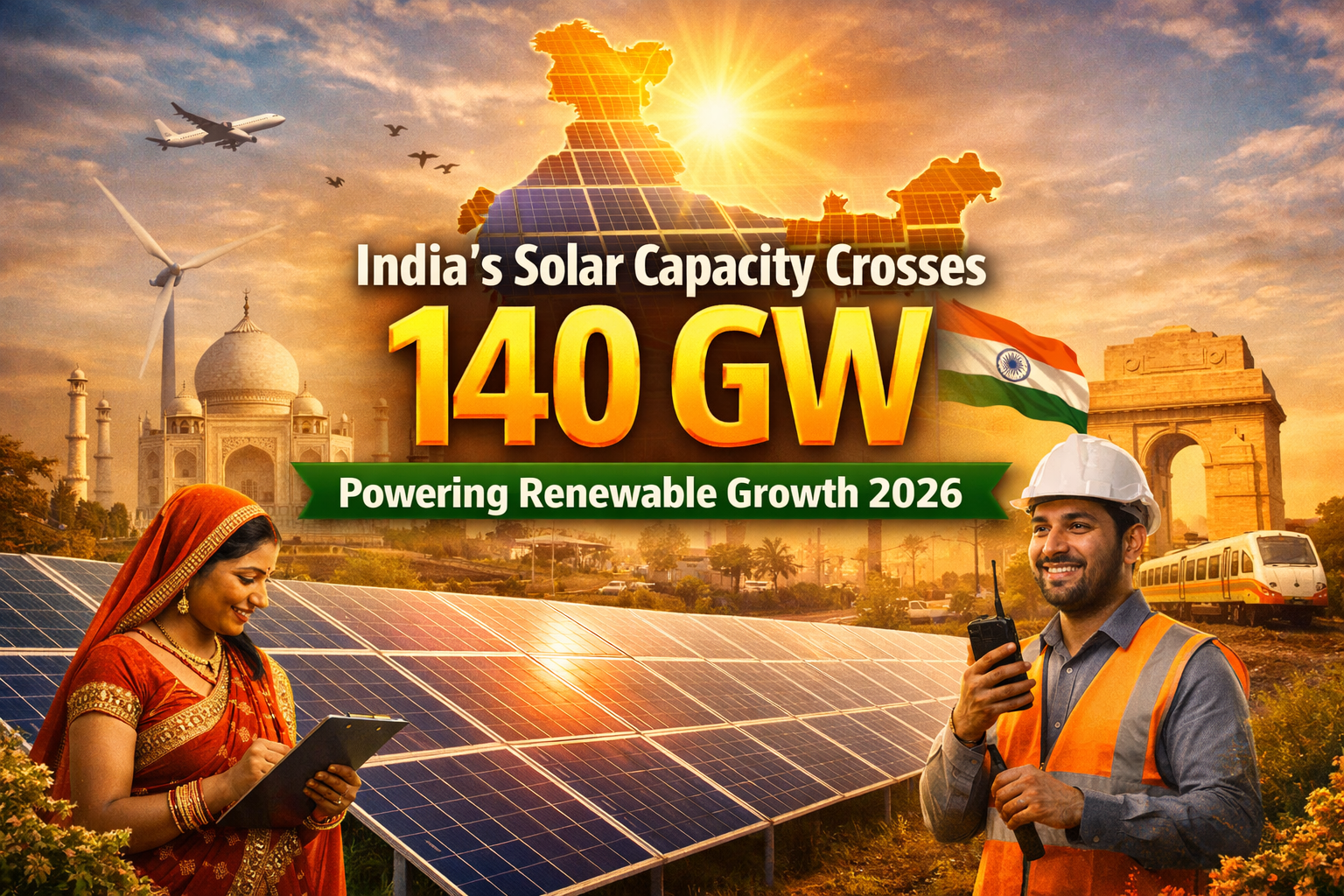
India has reached a landmark moment in its clean energy journey as India solar capacity crosses 140 GW. This achievement reflects more than just installed megawatts. It signals India’s transformation into a global renewable energy leader and a nation determined to build a low-carbon future. Over the past decade, solar power has moved from being an alternative source to becoming the backbone of India’s energy strategy.
India solar capacity has crossed 140 GW in 2026 according to industry reports and government updates.
Source: https://mnre.gov.in
The rapid rise of India solar capacity has been driven by bold government policies, falling technology costs, and strong private sector participation. Large solar parks across Rajasthan, Gujarat, Karnataka and Andhra Pradesh have changed the energy landscape. At the same time, rooftop installations on homes, schools, factories and offices have brought solar power directly to consumers. Together, these efforts have helped India reduce dependence on coal, lower electricity costs and create millions of new opportunities.
A decade ago, India had less than 3 GW of solar power. Crossing 140 GW within such a short period is a remarkable achievement for any major economy. Competitive bidding, transparent policies and international investment made solar the cheapest source of electricity in the country. Today, new solar tariffs are often lower than thermal power, proving that clean energy is not only environmentally right but also economically smart.
The importance of India solar capacity in 2026 goes far beyond power generation. India is one of the fastest-growing energy markets in the world. Demand is rising due to urbanisation, electric mobility, digital infrastructure and manufacturing growth. Solar energy offers a clean and affordable way to meet this demand without increasing pollution or import bills. Every new solar plant strengthens India’s energy independence and protects consumers from volatile global fuel prices.
Government initiatives have played a decisive role in this transformation. The PM Surya Ghar rooftop scheme has encouraged households to generate their own electricity with attractive subsidies. The Production Linked Incentive programme is building a domestic manufacturing ecosystem for modules, cells and components. Green Open Access rules have allowed industries to buy solar power directly, accelerating commercial and industrial adoption. These reforms created the foundation on which India solar capacity crossed 140 GW.
The economic impact of this growth is visible across the country. Solar projects have generated large-scale employment for engineers, technicians, construction workers and service providers. New businesses have emerged in financing, installation, maintenance and digital monitoring. International investors now see India as one of the most promising clean-energy markets. Billions of dollars are flowing into solar infrastructure, grid upgrades and battery storage.
Rooftop solar is becoming the next major engine of growth. Families and small businesses are cutting electricity bills by 30 to 70 percent. Net metering policies allow consumers to earn from excess generation. For MSMEs, solar power improves competitiveness by reducing operating costs. As awareness increases, rooftop systems will contribute a larger share of India solar capacity in the coming years.
Another important shift is the integration of solar with energy storage. Batteries allow solar power to be supplied even after sunset, supporting peak demand and grid stability. Hybrid projects combining solar, wind and storage are emerging as the future model. By 2026, round-the-clock renewable power will be a mainstream reality in India.
Different states have contributed in unique ways. Rajasthan and Gujarat leveraged vast land and high irradiation to build mega parks. Karnataka and Tamil Nadu created strong open-access markets. Uttar Pradesh and Maharashtra focused on rooftop expansion. This cooperative federal approach helped India solar capacity grow in a balanced manner.
Challenges still remain. Land acquisition, transmission congestion and financing for small consumers require continuous attention. Dependence on imported raw materials must be reduced through domestic manufacturing. However, these challenges are being addressed with policy innovation and technology upgrades.
New technologies are rapidly improving performance. Bifacial modules, single-axis trackers, robotic cleaning and AI-based forecasting are increasing plant efficiency. Digital platforms monitor generation in real time and reduce losses. Such innovations will ensure that India solar capacity delivers maximum value to the grid and consumers.
Corporate India has also embraced solar power. Airports, metro systems, data centres and manufacturing units are signing long-term power purchase agreements. Large brands are using solar to meet sustainability commitments and reduce carbon footprints. This corporate demand has become a major pillar of capacity addition.
The environmental benefits are equally powerful. Millions of tonnes of carbon emissions are avoided every year because of solar generation. Cleaner air means better public health and lower medical costs. Solar projects also save water compared to coal plants and help protect biodiversity when planned responsibly.
Beyond economics and environment, solar energy is creating social change. Remote villages now receive reliable electricity through mini-grids. Cold storage powered by solar is helping farmers reduce losses. Students can study at night and health centres can store vaccines safely. The rise of India solar capacity is directly improving quality of life.
Globally, India now stands among the top three solar nations. Crossing 140 GW has strengthened India’s voice in international climate negotiations and opened doors for green exports such as hydrogen and ammonia. The world increasingly looks at India as a model for large-scale energy transition in developing economies.
Looking toward 2026, the momentum is set to accelerate. Analysts expect India to move well beyond 180 GW of solar with rapid addition of storage and hybrid systems. Electric vehicle charging corridors, green hydrogen hubs and smart cities will rely heavily on solar power. The grid will become more flexible and digital to handle high renewable penetration.
Young people have a huge opportunity in this sector. Careers in design, installation, analytics, sales and entrepreneurship are expanding fast. Training programmes and skill missions are preparing a new workforce to support the next phase of India solar capacity.
Financing innovation is also unlocking growth. Green bonds, infrastructure investment trusts and carbon markets are providing long-term capital. Banks are designing specialised loans for households and MSMEs. As finance becomes easier, adoption will spread to every district.
Domestic manufacturing is gaining strength with new factories for cells, inverters, glass and structures. This reduces import dependence and creates local value chains. Atmanirbhar Bharat and India solar capacity are now closely connected goals.
Agriculture is another major beneficiary. Solar pumps under the PM-KUSUM scheme are lowering irrigation costs and reducing diesel use. Agro-photovoltaic models allow farmers to grow crops beneath panels, giving double income from the same land.
Digitalisation is making the system smarter. Advanced forecasting helps grid operators plan better. Peer-to-peer trading and community solar models are emerging. Startups are bringing innovation in fintech, IoT and rural electrification.
Most importantly, every new megawatt of solar takes India closer to its net-zero vision. Clean energy supports economic growth without repeating the high-pollution path of the past. The milestone of 140 GW proves that sustainable development is possible at scale.
India solar capacity crossing 140 GW is not the destination but the beginning of a larger transformation. It shows what the country can achieve with clear vision and collective effort. As India moves into 2026, the sun will power more homes, factories, vehicles and dreams than ever before. The future of Indian energy is bright, affordable and green.
Also Read : Budget 2026 Solar: India Gets 32% Boost