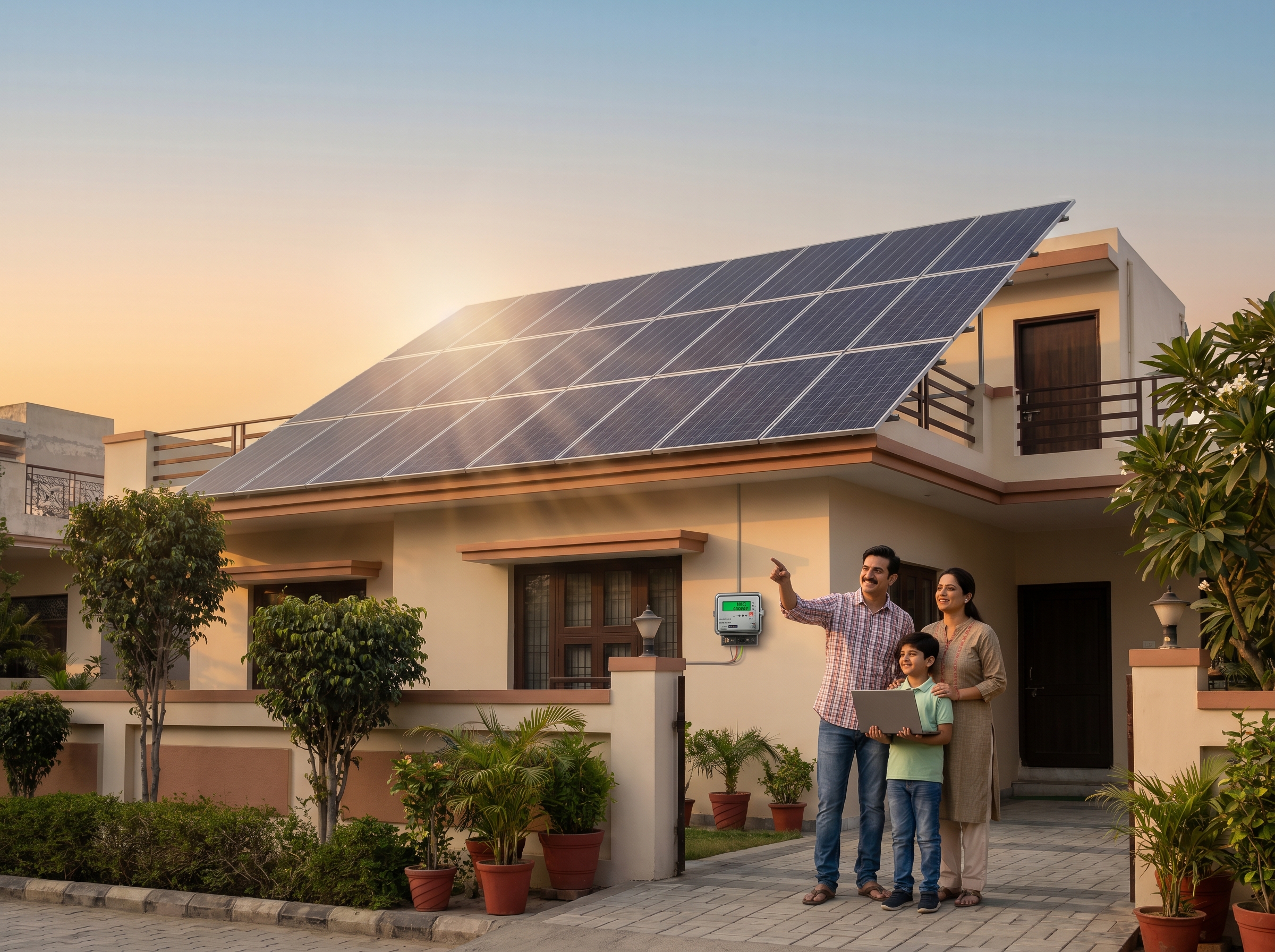
The rising cost of electricity in India is no longer just a concern it has become a serious financial burden for millions of households. Every year, electricity tariffs increase, and families find themselves paying higher bills despite trying to control usage. At the same time, power cuts, voltage fluctuations, and unreliable supply continue to affect daily life in many regions.
In this situation, solar for Indian homes is no longer a luxury or an “eco-friendly option” for a few it is rapidly becoming a practical, cost-saving necessity. With advancements in technology, strong government support, and increasing awareness, solar energy has reached a point where it makes both financial and logical sense for homeowners across India.
One of the biggest reasons driving this shift is simple: solar allows you to take control of your electricity expenses. Instead of being dependent on rising tariffs, you generate your own power. This shift from being a consumer to becoming a producer of electricity is fundamentally changing how Indian households think about energy.
Another major factor is the strong push from government initiatives like PM Surya Ghar Muft Bijli Yojana, which aims to make rooftop solar accessible to crores of households. Subsidies, simplified processes, and awareness campaigns have significantly reduced the barrier to entry, making solar installation easier than ever before.
Beyond financial savings, solar offers reliability. In areas where power cuts are frequent, having a solar system especially when combined with battery storage ensures uninterrupted electricity. This is particularly valuable for families working from home, students preparing for exams, or anyone relying on consistent power for daily activities.
From an environmental perspective, switching to solar also contributes to reducing carbon emissions. India is one of the fastest-growing energy consumers in the world, and the transition to renewable energy is essential for sustainable growth. By installing solar panels, individual households become part of this larger transformation.
But perhaps the most compelling reason is long-term value. A solar system is not an expense it is an investment. While there is an upfront cost, the system pays for itself over time through savings on electricity bills. Once the payback period is over, the electricity generated is essentially free for the remaining lifespan of the system, which can be 20–25 years or more.
Electricity bills in India have seen consistent growth over the past decade. Factors like increasing fuel costs, infrastructure upgrades, and growing demand have pushed tariffs upward. For a typical middle-class household, electricity bills can easily range from ₹2,000 to ₹10,000 per month depending on usage and location. Over a year, this adds up to a significant expense.
Solar changes this equation completely. By installing a rooftop solar system, a household can reduce or even eliminate its monthly electricity bill. In many cases, especially with net metering policies, excess electricity generated during the day can be sent back to the grid, further reducing costs.
Financially, this means predictable energy expenses. Instead of worrying about tariff hikes, you lock in your energy cost at the time of installation. Over the next two decades, this results in massive savings.
Another important reason to consider solar is energy independence. In a traditional setup, households are entirely dependent on the grid. Any disruption whether due to technical faults, weather conditions, or infrastructure issues directly impacts daily life.
Solar systems, particularly hybrid or off-grid setups, reduce this dependency. Even in grid-connected systems, having your own source of power provides a level of security that is increasingly valuable in today’s uncertain energy landscape.
In many parts of India, voltage fluctuations can damage appliances such as refrigerators, air conditioners, and televisions. Solar systems, when properly installed with quality inverters, provide more stable power, which helps protect these appliances and extend their lifespan.
The role of technology in making solar accessible cannot be overlooked. Modern solar panels are more efficient, durable, and affordable than ever before. Installation processes have become faster, and maintenance requirements are minimal. Most systems require only basic cleaning and periodic checks to maintain optimal performance.
In addition, monitoring systems allow homeowners to track energy generation in real time through mobile apps. This transparency helps users understand their consumption patterns and optimise usage for maximum savings.
Another compelling reason for switching to solar is the increasing availability of financing options. Earlier, the upfront cost was a major barrier. Today, many financial institutions offer loans specifically for solar installations, often with attractive interest rates and flexible repayment options.
This means that even households that cannot afford the full upfront cost can still switch to solar and pay for the system gradually, often using the savings from reduced electricity bills.
Property value is another aspect that is often overlooked. Homes equipped with solar systems are seen as modern, energy-efficient, and future-ready. This increases their market value and attractiveness to potential buyers.
In urban areas, where sustainability is becoming a key consideration, solar-equipped homes stand out. Even in semi-urban and rural regions, the ability to generate independent electricity is a strong selling point.
Solar also aligns with India’s long-term energy vision. The country has set ambitious targets for renewable energy capacity, aiming to reduce dependence on fossil fuels and increase sustainability. By adopting solar at the household level, individuals contribute directly to this national goal.
For families with children, solar adoption also has an educational value. It creates awareness about renewable energy, sustainability, and responsible consumption. It sets an example for the next generation, encouraging them to think about long-term impact rather than short-term convenience.
Another important factor is scalability. Solar systems can be expanded over time. If your energy needs increase due to additional appliances, electric vehicles, or other factors you can add more panels to your existing system.
This flexibility makes solar a future-proof solution. Unlike traditional energy setups, which are fixed and dependent on external supply, solar adapts to your needs.
Maintenance is often a concern for homeowners considering solar. However, modern systems are designed for durability and low upkeep. Regular cleaning to remove dust and occasional professional inspections are usually sufficient to keep the system running efficiently.
Most solar panels come with warranties of 20–25 years, and inverters typically have warranties of 5–10 years. This long lifespan ensures that the investment continues to deliver value over time.
In India’s climate, solar energy is particularly effective. With abundant sunlight throughout the year in most regions, solar panels can generate significant amounts of electricity. Even during monsoon seasons, systems continue to produce power, although at reduced levels.
This geographical advantage makes India one of the most suitable countries for solar adoption.
Another growing trend is the integration of solar with battery storage. While traditional grid-connected systems rely on the grid for backup, battery systems store excess energy for use during the night or power cuts.
Although battery systems increase the initial cost, they provide greater independence and reliability, especially in areas with frequent outages.
From a broader perspective, the shift to solar is also about mindset. It represents a move towards self-sufficiency, sustainability, and smarter financial planning. It is not just about saving money it is about making a conscious decision to adopt a better way of living.
For many households, the hesitation to switch to solar comes from lack of information or misconceptions. Some believe it is too expensive, others think it requires too much maintenance, and some are unsure about the installation process.
In reality, the situation has changed significantly. Costs have decreased, processes have become streamlined, and support systems are in place to guide homeowners through every step.
Choosing the right installer and system is crucial. A well-designed system tailored to your energy needs ensures maximum efficiency and savings. It is important to work with experienced professionals who understand local conditions, policies, and technical requirements.
As awareness grows, more and more Indian households are making the switch. What was once considered an alternative is now becoming mainstream.
The decision to adopt solar is not just about the present it is about the future. It is about securing your energy needs, reducing your expenses, and contributing to a cleaner environment.
In a country like India, where sunlight is abundant and energy demand is rising, the case for solar is stronger than ever. The combination of financial benefits, government support, technological advancements, and environmental impact makes solar an obvious choice for homeowners.
The question is no longer whether solar is worth it. The real question is: how soon can you start benefiting from it?
Because every month you delay is another month of paying high electricity bills that could have been avoided.
Switching to solar today is not just a smart decision it is a strategic one. It is about taking control, saving money, and building a better future for your family and the country.
Under the PM Surya Ghar Muft Bijli Yojana, eligible households can receive substantial subsidies to reduce the cost of installing rooftop solar systems. You can check eligibility and apply directly on the official portal.
Also Read :- Lucknow Becomes India’s No. 1 Solar City: How 87,000 Rooftop Installations Are Changing the Energy Future