
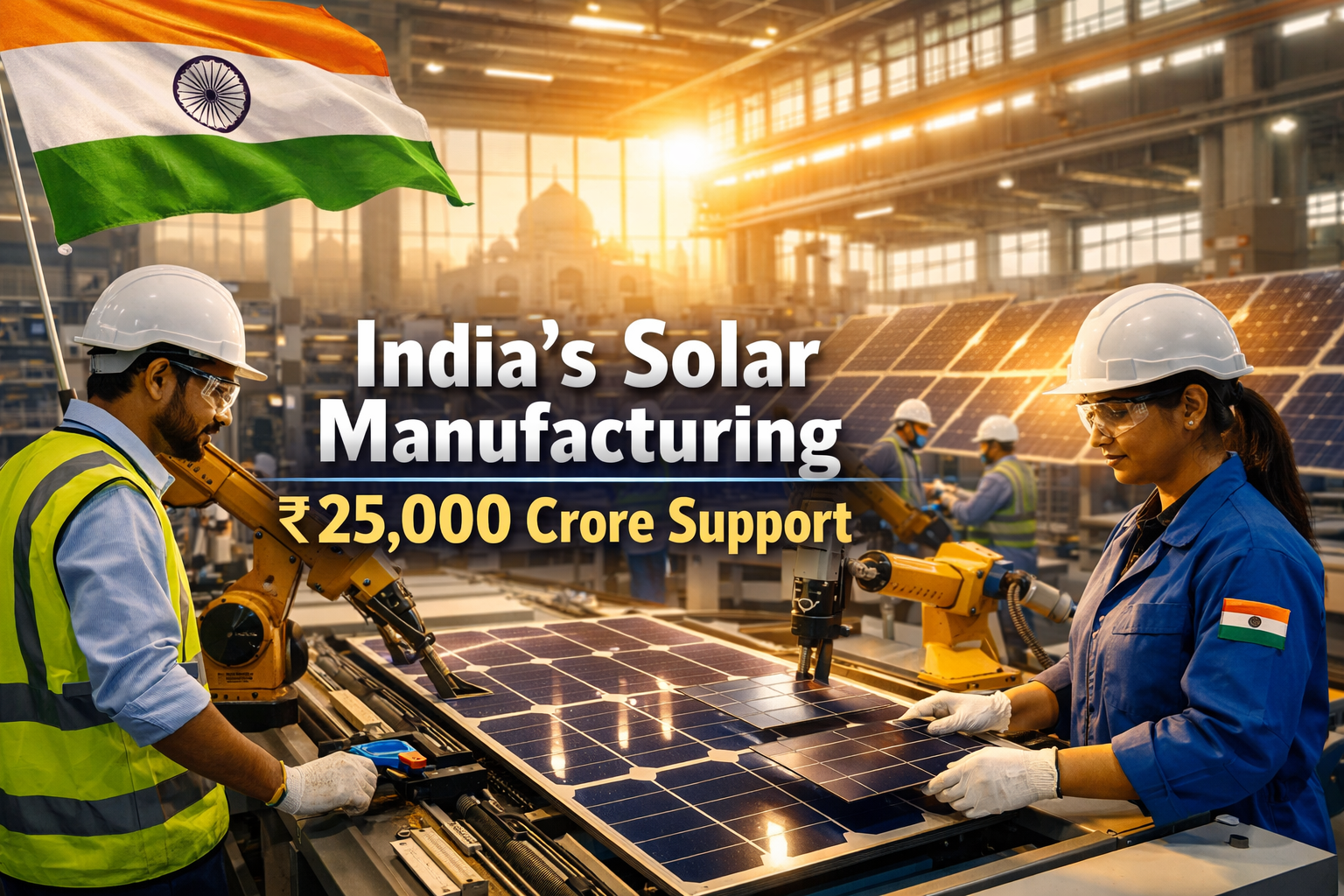
India’s renewable energy sector is undergoing one of the most transformative phases in its history. With ambitious clean energy targets and a rapidly growing electricity demand, solar power has emerged as the backbone of the country’s energy transition. However, despite massive deployment of solar projects across the country, India still relies heavily on imported solar components especially wafers, ingots, and solar cells.
Recently, India’s solar industry has proposed a major financial support package from the government worth ₹20,000–₹25,000 crore to boost domestic manufacturing. The proposal aims to strengthen India’s upstream solar supply chain by encouraging local production of key components like solar ingots and wafers, which are currently imported in large quantities.
Industry leaders believe that with targeted policy support and viability gap funding, India can build around 50 GW of domestic ingot and wafer manufacturing capacity. This would reduce dependency on imports, enhance energy security, and help the country meet its ambitious renewable energy goals.
This blog explores the background of India’s solar manufacturing ecosystem, why the industry is seeking ₹25,000 crore in support, and how this move could reshape the future of renewable energy manufacturing in the country.
The Rise of Solar Power in India
India has emerged as one of the fastest-growing solar markets in the world. Over the past decade, the government has aggressively promoted solar power through various policies, incentives, and national missions.
One of the most important initiatives driving the growth of solar energy is the National Solar Mission, which aims to position India as a global leader in solar energy deployment and manufacturing.
The mission focuses on:
- Reducing the cost of solar power generation
- Expanding solar capacity nationwide
- Encouraging domestic manufacturing of solar equipment
- Supporting research and innovation in solar technologies
As a result, India has witnessed rapid expansion in solar capacity. Large-scale solar parks, rooftop installations, and solar-powered infrastructure projects are now common across the country.
Additionally, the government has launched major schemes such as the Pradhan Mantri Surya Ghar Muft Bijli Yojana, which aims to install rooftop solar systems for millions of households and provide up to 300 units of free electricity every month.
Such initiatives are significantly increasing the demand for solar panels and related equipment in India.
India’s Solar Manufacturing Landscape
Despite strong growth in solar deployment, the domestic manufacturing ecosystem in India is still developing. The solar value chain consists of several stages:
- Polysilicon production
- Ingot manufacturing
- Wafer production
- Solar cell manufacturing
- Solar module assembly
India currently has strong capacity in solar module manufacturing, but the upstream stages such as ingots and wafers are limited.
For instance, several Indian companies manufacture solar modules at large scale. Companies like Vikram Solar, one of India’s leading solar manufacturers, have significantly expanded production capacity in recent years.
However, many manufacturers still rely on imported wafers and cells to assemble modules.
This imbalance creates a supply chain dependency that exposes the industry to global price fluctuations, geopolitical risks, and trade restrictions.
The Dependence on Imports
One of the biggest challenges facing the Indian solar industry is its reliance on imports, particularly from countries with well-established solar manufacturing ecosystems.
Most solar wafers and ingots used in Indian solar modules are imported. This dependence increases costs and reduces the competitiveness of domestic manufacturers.
Industry experts believe that without strong upstream manufacturing, India will struggle to become a global solar manufacturing hub.
Key challenges include:
- High capital investment required for wafer and ingot plants
- Limited access to advanced manufacturing technology
- Dependence on imported equipment
- Lack of large-scale integrated production facilities
To overcome these challenges, the industry is seeking financial support from the government.
Why the Solar Industry is Seeking ₹25,000 Crore Support
India’s solar industry has proposed a ₹20,000–₹25,000 crore viability gap funding (VGF) scheme to support domestic manufacturing.
The funding is intended to:
- Build domestic ingot and wafer manufacturing capacity
- Reduce reliance on imports
- Strengthen the solar supply chain
- Improve cost competitiveness of Indian manufacturers
According to industry bodies, the funding could help establish around 50 GW of local ingot and wafer manufacturing capacity.
This capacity would significantly strengthen India’s position in the global solar manufacturing ecosystem.
What is Viability Gap Funding (VGF)?
Viability Gap Funding is a government financial support mechanism used to make large infrastructure projects economically viable.
In sectors like renewable energy and manufacturing, VGF helps bridge the gap between project costs and expected revenue.
For solar manufacturing, VGF could support:
- Capital expenditure for manufacturing plants
- Technology acquisition
- Equipment procurement
- Infrastructure development
Industry leaders believe that VGF is essential to make domestic manufacturing competitive with global producers.
Strengthening India’s Solar Supply Chain
A strong supply chain is critical for the growth of the solar industry.
Currently, India’s solar supply chain faces several limitations:
- Limited upstream manufacturing
- Dependence on imported raw materials
- Technology gaps
- Supply chain disruptions
By investing in domestic manufacturing, India can create a more resilient solar ecosystem.
A stronger supply chain would also support:
- Faster project deployment
- Lower costs for solar installations
- Reduced import bills
- Increased export potential
The Role of Government Policies
Government policy plays a crucial role in shaping the growth of solar manufacturing in India.
Several initiatives have already been introduced to support domestic production.
One of the most important policies is the Production Linked Incentive (PLI) scheme, which encourages manufacturers to expand production in India by providing financial incentives based on output.
The PLI scheme aims to:
- Boost domestic manufacturing
- Reduce imports
- Create jobs
- Attract global investments
However, industry leaders believe that additional support is needed to develop upstream manufacturing capabilities.
Opportunities for Indian Solar Manufacturers
The proposed ₹25,000 crore support package could unlock massive opportunities for Indian solar manufacturers.
Potential benefits include:
1. Increased Manufacturing Capacity
New investments could lead to large-scale production facilities for wafers, ingots, and solar cells.
2. Job Creation
Solar manufacturing expansion could create thousands of jobs in engineering, manufacturing, and technology.
3. Export Opportunities
India could become a major exporter of solar components to global markets.
4. Technological Advancement
Investment in research and development could improve solar technology innovation in India.
5. Energy Security
Domestic manufacturing reduces reliance on imports and strengthens national energy security.
Impact on India’s Renewable Energy Goals
India has set ambitious renewable energy targets for the coming decades.
The country aims to achieve 500 GW of non-fossil fuel energy capacity by 2030, with solar power playing a major role.
To achieve these targets, the country must significantly expand both solar deployment and manufacturing.
A strong domestic manufacturing ecosystem ensures that:
- Solar projects are deployed faster
- Costs remain competitive
- Supply chain disruptions are minimized
The proposed funding support could accelerate India’s progress toward these goals.
Challenges in Building Solar Manufacturing Capacity
While the proposed funding could boost domestic manufacturing, several challenges remain.
High Capital Costs
Solar manufacturing plants require significant capital investment, particularly for upstream production.
Technology Barriers
Advanced manufacturing technologies are often controlled by established global players.
Equipment Imports
India still relies on imported machinery for certain manufacturing processes.
Market Competition
Global solar manufacturers operate at massive scale, making price competition difficult.
Overcoming these challenges will require strong collaboration between government, industry, and technology providers.
Global Competition in Solar Manufacturing
The global solar manufacturing market is highly competitive.
Several countries dominate the industry due to large-scale investments and integrated supply chains.
India aims to strengthen its position by expanding domestic production capacity and encouraging innovation.
With the right policy support, India could emerge as a major solar manufacturing hub.
Future Outlook for India’s Solar Industry
The future of India’s solar industry looks promising.
Key trends shaping the industry include:
- Rapid growth in solar installations
- Increasing investment in renewable energy
- Rising demand for clean electricity
- Expansion of solar manufacturing capacity
With the proposed ₹25,000 crore support package, India could accelerate its transition toward a self-reliant solar manufacturing ecosystem.
This would strengthen the country’s energy security, create economic opportunities, and contribute to global climate goals.
Conclusion
India’s solar industry stands at a critical turning point. While the country has made remarkable progress in deploying solar power, the next phase of growth will depend on building a strong domestic manufacturing ecosystem.
The proposed ₹25,000 crore support package could play a crucial role in achieving this objective. By investing in upstream manufacturing such as ingots and wafers, India can reduce import dependence, improve supply chain resilience, and position itself as a global leader in solar manufacturing.
As the world transitions toward renewable energy, countries with strong manufacturing capabilities will have a significant competitive advantage. With the right policies, investments, and industry collaboration, India has the potential to become a major global hub for solar manufacturing.
The coming years will determine how effectively India can transform its solar ambitions into a powerful manufacturing ecosystem that supports sustainable growth, energy security, and environmental protection.
Also Read : MSEDCL Tender Reduces Rooftop Solar Cost by ₹15,000 per kW in India