
Introduction
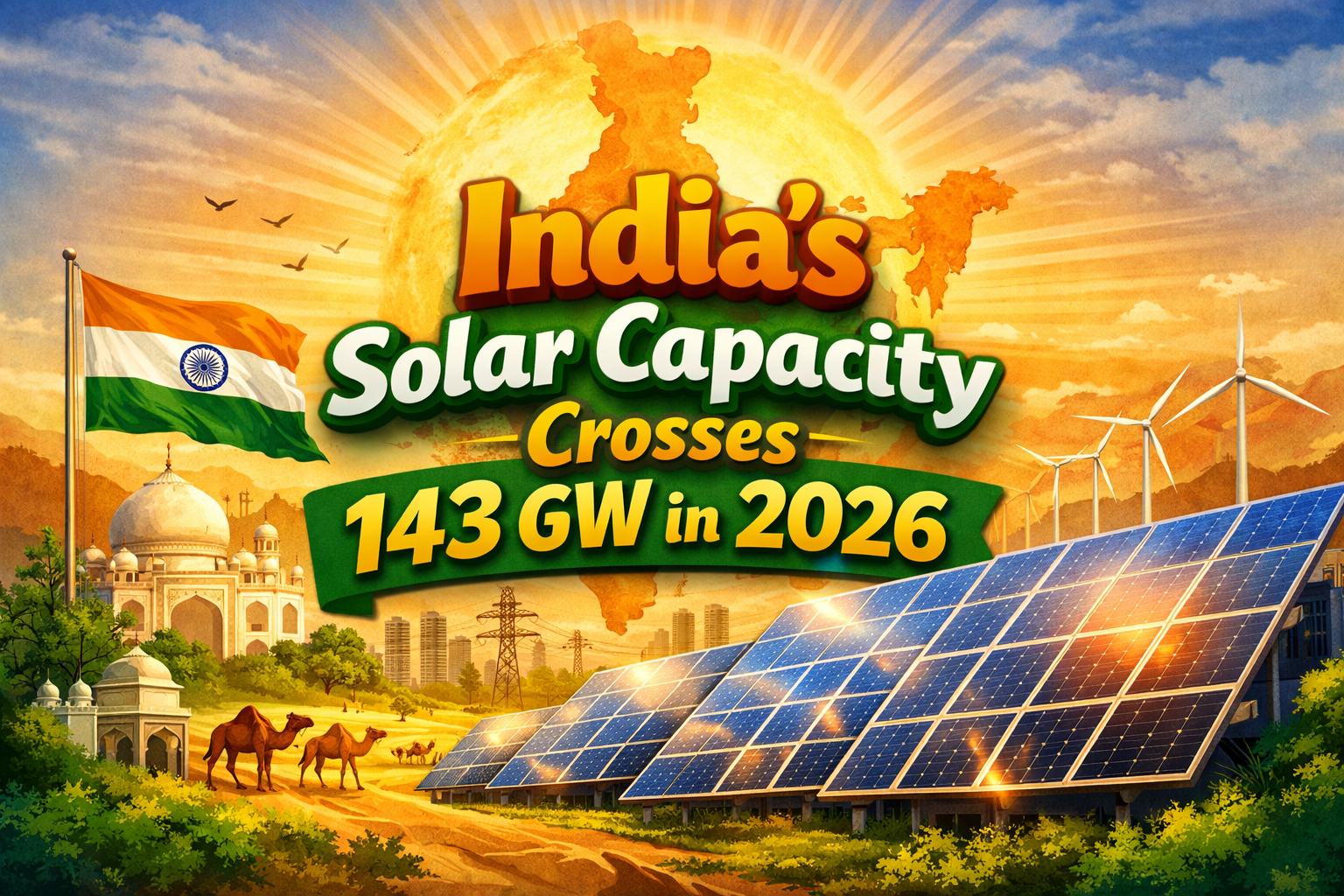
India’s renewable energy journey has reached a historic milestone in early 2026, as the country’s solar power capacity crosses 143 gigawatts (GW). This achievement highlights India’s rapid transformation into a global clean energy leader and reinforces its commitment to reducing carbon emissions while meeting growing energy demands.
Over the past decade, India has witnessed an exponential rise in solar installations—from just 2.8 GW a decade ago to over 140 GW today. This remarkable growth is driven by strong government policies, falling solar costs, increasing private investments, and rising awareness of sustainability.
In this blog, we will explore everything you need to know about India’s solar capacity milestone, including growth drivers, challenges, opportunities, and what lies ahead.
According to official data from the Ministry of New and Renewable Energy, India’s total installed solar capacity has reached over 143 GW, marking a significant milestone in the country’s clean energy journey.
India’s Solar Capacity Reaches 143 GW: What It Means
Early 2026 saw India’s solar capacity surpass 143 GW, marking a significant shift in the country’s energy landscape. Solar energy now forms a major portion of India’s renewable energy mix and continues to lead capacity additions.
According to recent industry data, India’s installed solar capacity reached approximately 143.6 GW by February 2026. This growth is part of a broader renewable energy expansion, with solar contributing the largest share.
Additionally, India added a record amount of renewable capacity in FY2025–26, with solar accounting for nearly 35 GW of new installations.
Why This Milestone Matters
- Positions India among the top solar markets globally
- Strengthens energy security by reducing fossil fuel dependence
- Supports climate goals and carbon reduction commitments
- Boosts economic growth and job creation
Growth Trends Driving India’s Solar Boom
India’s solar growth is not accidental it is the result of multiple aligned factors.
1. Government Policies & Targets
The Indian government has set ambitious renewable energy targets, including 500 GW of non-fossil fuel capacity by 2030.
Policies such as:
- Solar Park Scheme
- Production Linked Incentive (PLI) for solar manufacturing
- Rooftop solar subsidies
have accelerated solar adoption across sectors.
2. Record Capacity Additions
India has been adding solar capacity at an unprecedented pace.
- Around 35 GW of solar capacity added in FY2025–26
- Total renewable additions crossed 52 GW in 10 months
This rapid expansion reflects strong project pipelines and investment confidence.
3. Falling Solar Costs
Solar energy has become one of the cheapest sources of electricity in India. Declining panel costs and improved efficiency have made solar projects more viable.
This cost advantage has encouraged:
- Industrial adoption
- Residential rooftop installations
- Utility-scale solar parks
4. Rise of Large Solar Parks
India is home to some of the world’s largest solar parks, such as:
- Bhadla Solar Park (Rajasthan)
Large-scale projects contribute significantly to total capacity and help achieve economies of scale.
5. Growth in Rooftop Solar
Rooftop solar is gaining momentum, especially in urban areas. Reports indicate strong growth in residential and commercial rooftop installations, contributing to overall capacity expansion.
Role of Solar in India’s Energy Transition
Solar energy is now at the centre of India’s energy strategy.
Reducing Carbon Emissions
Solar power helps reduce reliance on coal, which still dominates India’s energy mix.
Supporting Energy Demand
India’s electricity demand is rising rapidly due to:
- Urbanization
- Industrial growth
- Digital infrastructure
Solar energy provides a scalable solution to meet this demand.
Energy Independence
Solar reduces dependence on imported fossil fuels, improving national energy security.
Future Growth Projections
India’s solar journey is far from over.
Expected Capacity Additions
- Around 42.5 GW new solar capacity expected in 2026
- Solar installations expected to grow significantly through 2030
Global Position
India is expected to become the following:
- One of the largest solar markets globally
- A major manufacturing hub for solar equipment
Solar + Storage Revolution
The future of solar lies in combining it with battery storage systems to ensure reliable power supply.
Key Challenges in Solar Growth
Despite rapid progress, India’s solar sector faces several challenges.
1. Grid Infrastructure Limitations
As solar capacity increases, managing grid stability becomes critical.
2. Policy Uncertainty
Frequent regulatory changes can impact investor confidence.
3. Land Acquisition Issues
Large solar projects require vast land areas, leading to challenges in land availability.
4. Import Dependency
India still relies on imports for certain solar components, especially from China.
5. Supply Chain Disruptions
Global geopolitical tensions can affect solar equipment availability.
Emerging Opportunities in the Solar Sector
India’s solar growth opens up multiple opportunities: Business Opportunities
- Solar installation companies
- Solar EPC (Engineering, Procurement, Construction)
- Solar panel manufacturing
Job Creation
Solar sector growth is generating employment in:
- Engineering
- Project management
- Sales and marketing
Residential Adoption
Homeowners are increasingly adopting rooftop solar to reduce electricity bills.
Agrivoltaics
Combining agriculture and solar panels is an emerging trend in India.
Technology Trends in Solar Energy
Advanced Solar Panels
New technologies like bifacial panels and high-efficiency modules are improving output.
Smart Solar Systems
AI and IoT are being used for:
- Monitoring performance
- Predictive maintenance
Hybrid Systems
Solar is increasingly being combined with wind and storage systems for better efficiency.
🇮🇳 India vs Global Solar Growth
Globally, solar installations crossed 600 GW in 2025, with rapid expansion continuing into 2026.
India stands out due to the following:
- Fast growth rate
- Strong government support
- Large-scale deployment
State-wise Solar Leaders in India
Top states contributing to solar capacity include:
- Rajasthan
- Gujarat
- Maharashtra
- Karnataka
These states offer favourable conditions such as the following:
- High solar irradiation
- Large land availability
- Supportive policies
Future Outlook: Road to 2030
India’s solar sector is expected to play a crucial role in achieving climate goals.
Key Targets
- 500 GW renewable energy capacity by 2030
- Significant increase in solar share
Growth Drivers
- Continued policy support
- Technological innovation
- Increased private investment
Conclusion
India’s solar capacity crossing 143 GW in 2026 is more than just a number—it represents a transformative shift in the country’s energy landscape.
With strong policy backing, technological advancements, and increasing investments, India is well on its way to becoming a global solar powerhouse. However, addressing challenges like grid infrastructure and supply chain dependencies will be crucial for sustaining this growth.
As the world moves toward clean energy, India’s solar success story serves as a powerful example of how emerging economies can lead the renewable revolution.
Also Read: How Falling Battery Costs Are Igniting the Race for Round-the-Clock Solar Power